
Why Tangier feels different
Tangier faces the Strait of Gibraltar at Morocco’s northern edge, where Atlantic and Mediterranean geographies meet. That position shaped a port city with Moroccan, Andalusian, African and European layers rather than a single architectural period. Read the waterfront, diplomatic buildings, religious sites and café culture as parts of that long exchange without turning the city into the simplistic slogan of “Europe meets Africa.”
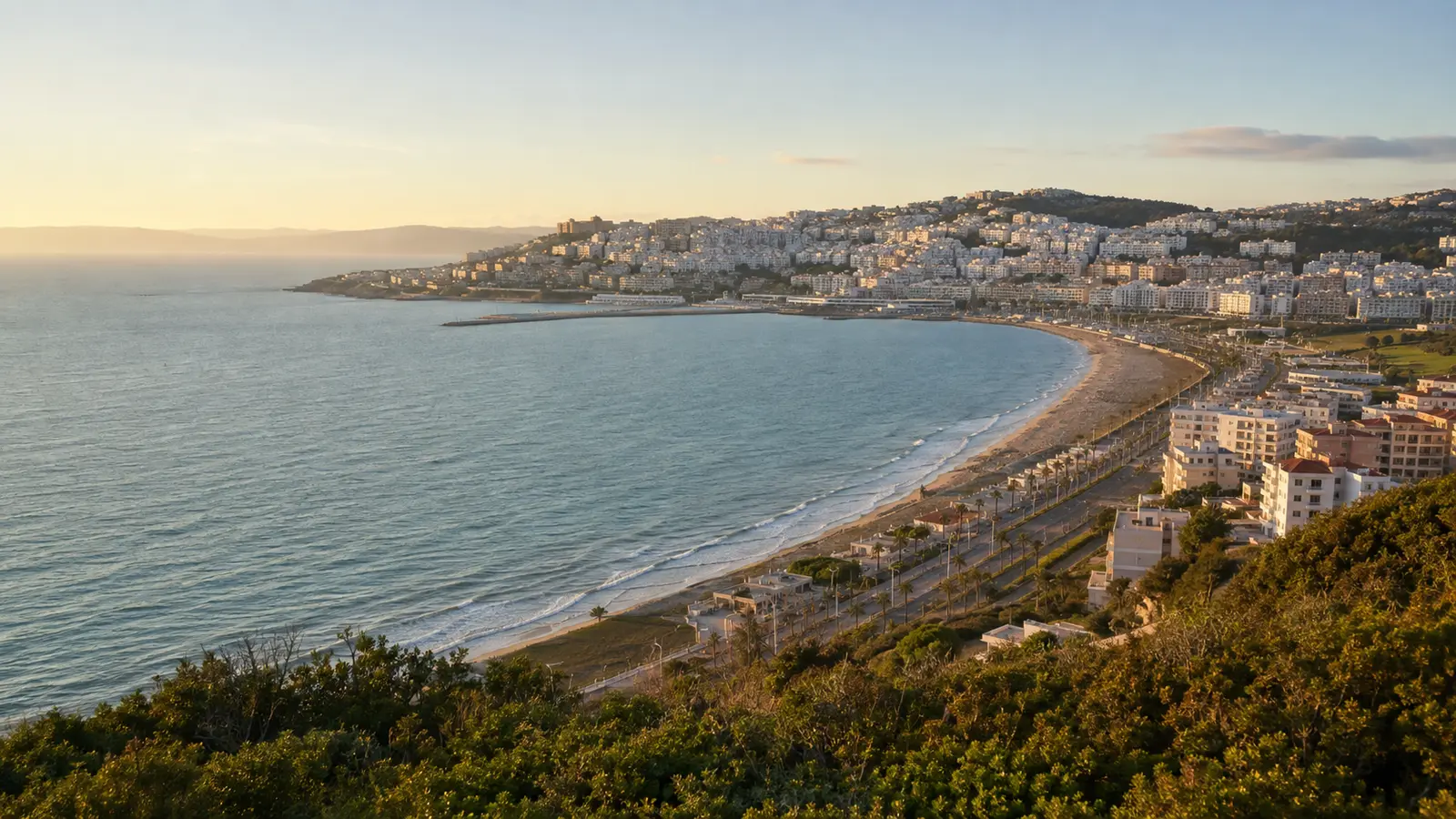
The city’s geography becomes clearest from an elevated point: the medina falls toward Tangier City port, the bay curves east toward Malabata and the Strait frames the horizon. Use that view to orient the next walk, then return to street level and notice how languages, building periods and commercial life overlap without reducing Tangier to a border slogan.
- Use the Kasbah for geographic orientation
- Notice how the port and bay shape movement
- Treat international-era history as one layer, not the whole story
Check current details: Official Tangier destination overview · Moroccan National Tourist Office — medinas and beaches
Neighborhood orientation before you walk
The Kasbah occupies the highest old-city ground; the medina descends toward the port; Grand Socco marks a useful threshold to the newer city. Boulevard Pasteur and surrounding streets form the practical Ville Nouvelle core. Malabata follows the bay east, while Tanja Balia is a residential area near the modern Tanger Ville and City Mall zone by car. Build routes downhill when possible and avoid assuming every named neighborhood is adjacent.
These areas also call for different transport choices. The old city rewards walking but includes slopes and steps; the bay is easier to cover by taxi when time is limited; Tanja Balia works as a residential base rather than a sightseeing circuit. Tell a driver a known destination as well as the neighborhood name, and keep the return address written down.
- Kasbah and medina for heritage
- Ville Nouvelle for services and broad avenues
- Malabata and the bay for modern waterfront time
- Tanja Balia for a residential sea-view base
A realistic two-day route
On day one, begin near Grand Socco, enter the medina, climb gradually to the Kasbah and pause before descending toward the port-facing side. Use late afternoon for the Ville Nouvelle and a viewpoint rather than adding a coast excursion. On day two, reserve a half-day for Cape Spartel and the Caves of Hercules, then return with enough margin for dinner, sunset or onward transport.
If arrival fatigue is significant, divide the first day again: Grand Socco and a short medina loop before lunch, then the Kasbah after a proper rest. Cape Spartel belongs on day two even when a driver offers to add it immediately. That separation preserves enough attention for the city and avoids turning sunset into a race through coastal traffic.
- Morning: medina before the busiest period
- Midday: indoor cultural stop and lunch
- Afternoon: one geographic cluster only
- Evening: return before committing to a departure
Essential places and what belongs outside the city
The Kasbah Museum, housed in the former sultan’s palace, gives regional context; the American Legation documents a different chapter of Tangier’s international history. The Phoenician tomb area is a viewpoint as well as an archaeological place. Cape Spartel and the Caves of Hercules sit west of the center and should be planned as an excursion, not squeezed between medina stops. Verify each venue’s current access directly before leaving.
For the Kasbah Museum, consult the museum authority rather than copying hours from an old itinerary. The American Legation likewise deserves time for its collection and building, while the tomb area asks for care around uneven ground and nearby graves. At the coast, follow current barriers and ticket instructions; rough Atlantic weather can change the character of the excursion.
- Check the museum’s official listing
- Pair Cape Spartel with the caves only if time allows
- Respect barriers and residential surroundings
- Do not rely on old blog opening hours
Eating and café culture without chasing a ranked list
A useful Tangier food day can move from a bakery or breakfast counter to a fish-focused lunch and a tea terrace. Choose kitchens by visible turnover, a clear specialty and transparent ordering rather than by aggressive street solicitation. Ask what is available that day, confirm the price before ordering when it is not displayed and give yourself enough time: café culture is part of the experience, not merely a refueling stop.
A simple ordering question—“What do you prepare most often?”—usually reveals more than a menu designed to cover every Moroccan dish. At fish counters, establish whether the price is per portion, piece or weight and whether cooking is separate. For a longer food plan, the dedicated Tangier eating guide provides selection criteria without pretending one restaurant will remain the permanent winner.
- Breakfast: breads, eggs, olives and tea
- Lunch: ask what fish is fresh and how it is priced
- Cafés: order something and stay considerate of the table
- Follow current food-safety judgment, not hype
Arrival and movement
Tanger Ville is the modern rail station for checking current ONCF services. Tangier City port is the central ferry arrival point, while Tanger Med is a separate port well east of the city and requires its own transfer plan. Ibn Battouta Airport is outside the center. Petit taxis handle city journeys; agree that the meter is used or settle the fare before moving when local practice requires it.
A ferry ticket must say Tangier City if you expect to arrive beside the medina; Tanger Med is a different complex and needs a longer transfer. At Tanger Ville, consult ONCF for the exact train and platform information. For any fixed departure, plan backward from check-in or boarding requirements, then add city traffic rather than treating the published departure as the time to reach the terminal.
- Confirm the exact port on every ticket
- Use ONCF for live rail times and fares
- Keep the destination written on your phone
- Build a buffer before ferries, trains and flights
Check current details: Official Tangier destination overview · Moroccan National Tourist Office — medinas and beaches
Where to stay: medina character or modern convenience
A medina stay puts lanes and evening atmosphere close at hand but can involve stairs, luggage carries and vehicle drop-offs outside pedestrian areas. A modern or residential base can make rail access, kitchens and longer stays easier. The Tangier Sea View Apartment at the entrance to Tanja Balia is a private 50-square-metre, one-bedroom option for up to two guests, with a kitchen, Wi-Fi, washer-dryer, self check-in and a shared rooftop; it is a third-floor walk-up with no elevator.
The apartment is best suited to a solo traveler or couple who values self-catering, laundry and quick driving access to the Tanger Ville area. It is not the right fit for anyone who needs an elevator, central-medina doorstep access or space for extra visitors. Photos, live availability, calculated total, house rules and cancellation terms are maintained on the Three Shores listing, which should be checked before reserving.
- Sea view from the living room
- Tanger Ville and City Mall are about two minutes away by car
- One queen bed and one bathroom
- Check live availability, total and policies on the listing