
Why Rabat rewards one or two full days
As Morocco’s national capital, Rabat supports government, universities, residential neighborhoods and a working waterfront alongside heritage tourism. The result feels more legible than a maze-focused visit: broad modern avenues connect with the medina and older monuments, while the Atlantic and Bouregreg provide clear geographic edges. One day covers the central spine; two days allow an archaeological or museum layer.
Rabat’s calmer pace makes details easier to notice: clipped gardens beside administrative avenues, older walls crossing the modern plan and the river separating Rabat from Salé without severing their relationship. The city is not empty when it feels orderly. Commutes, official business and university life set a rhythm that differs from visitor-heavy medinas.
- One day for the central heritage walk
- Two days for Chellah, museums or Salé
- Use river, ocean and tram lines for orientation
Check current details: UNESCO Rabat World Heritage record · Moroccan National Tourist Office — medinas and heritage
Day one from Hassan Tower to the river
Begin at the Hassan Tower and mausoleum precinct when officially accessible, then move toward the medina for lunch and continue to the Kasbah of the Udayas. Finish near the Bouregreg or river-facing terraces before dark. The route is long enough without adding Chellah. Dress respectfully, follow posted photography restrictions and expect access changes during ceremonies or official events.
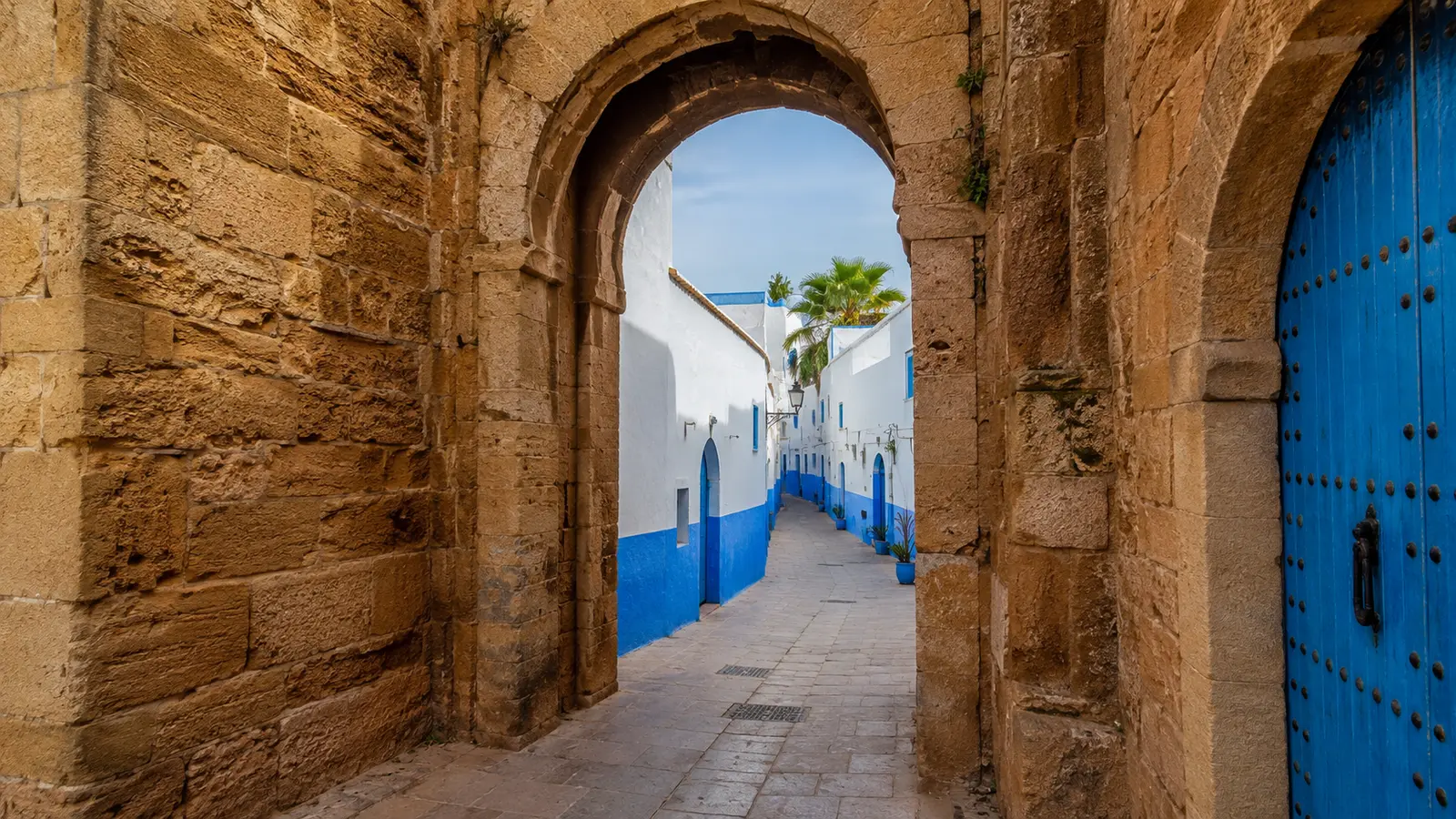
The Hassan precinct, central medina and Udayas route is best walked in that general sequence because it progresses toward the river. Check whether any state ceremony changes access before setting out. In the kasbah, blue-and-white lanes are residential; use public passages and resist entering a doorway or terrace because a photo caption online implied it was open.
- Morning at the Hassan precinct
- Midday through the medina
- Afternoon in the kasbah
- Sunset near the Bouregreg
Day two: Chellah, museums, gardens or Salé
Choose two compatible interests rather than crossing the city repeatedly. Chellah requires current access verification; a museum can provide weather shelter; the Jardin d’Essais connects directly with the modern-city heritage. Salé, across the Bouregreg, deserves its own measured visit rather than being treated as a decorative backdrop. Tram and walking combinations are often more predictable than improvising taxis all day.
Chellah can absorb more time than expected when open because archaeological, funerary and garden layers share the site. Pair it with one museum or the botanical garden, not a second cross-city marathon. Salé is better approached with a defined destination and return tram stop than as an aimless extension after sunset.
- Verify Chellah access
- Pair one indoor and one outdoor stop
- Use the tram for cross-city movement
- Give Salé a defined route
Food and café pauses by neighborhood
Near the medina, look for breads, grills, soups and small kitchens with visible turnover. In the modern city, cafés support a slower breakfast or work break; near the river, choose based on current menu and setting, not the promise of a permanent “best view.” Confirm prices before ordering when not displayed and give a busy table back when you have finished during peak periods.
A café near the station serves a different need from a river-view terrace, and neither should be judged by the same criteria. For breakfast or work, check opening time, Wi-Fi etiquette and table turnover. For a destination meal, review the current menu and reservation policy. Rabat’s everyday neighborhood kitchens can be more useful than crossing the city for a ranking.
- Medina for focused traditional counters
- Modern avenues for café breaks
- River area for a deliberate late stop
- Prefer turnover and specialty to rankings
Stations, tram and Casablanca connections
Rabat Ville and Rabat Agdal are different stations; select the one that matches the live ONCF itinerary and your accommodation. The tram links major urban axes and crosses toward Salé, but service notices and payment methods should be checked locally. Casablanca is an easy rail continuation when schedules align, yet airport or flight connections still require generous buffers beyond the nominal train time.
Rabat Ville is convenient to the center; Rabat Agdal may suit other routes or accommodation. A ticket that says “Rabat” is not enough information when coordinating a pickup. The tram can simplify movement to Salé and across central corridors, but luggage and peak commuting conditions should influence whether it is comfortable for an arrival transfer.
- Read the full station name
- Use ONCF for current departures
- Check tram service notices
- Keep a transfer margin to flights
Check current details: UNESCO Rabat World Heritage record · Moroccan National Tourist Office — medinas and heritage
A lower-friction first stop
Rabat suits travelers who want a first encounter with Moroccan public life without immediately navigating a highly commercial tourist core. It is still a capital with traffic, formal spaces and busy commuting periods. Stay near a transport axis, learn a few greetings, dress for religious and administrative settings, and use the first day to establish cash, connectivity and rail routines for the rest of the trip.
New visitors can use Rabat to test a modest medina walk, learn taxi practice and become familiar with checking ONCF departures before more complicated stops. The capital also offers easy access to pharmacies, banks and mobile-service shops. Solving those practical needs here leaves Fes and Marrakech days available for heritage rather than administrative chores.
- Choose accommodation near a clear axis
- Use the first day for practical setup
- Keep documents secure near state buildings
- Treat calm as normal city life, not emptiness