
Casablanca’s actual role
Casablanca is a port, business center and transportation hub whose twentieth-century scale is central to its identity. The old medina exists, but it does not organize the visitor experience in the way Fes el-Bali does. Expect wide roads, major intersections, commuter flows and neighborhoods separated by real travel time. The city rewards an architectural or food lens more than a generic “top ten” chase.
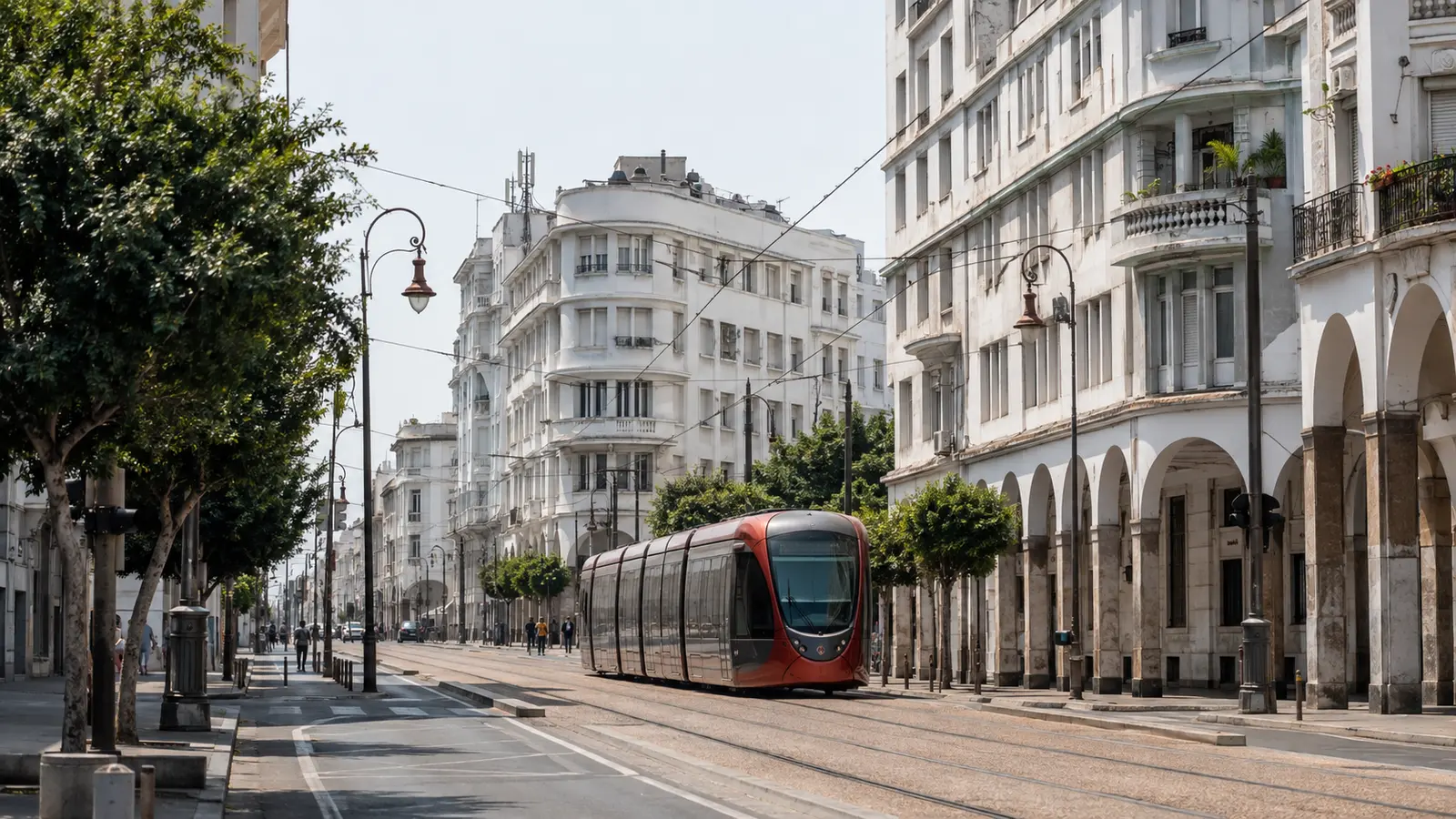
Casablanca’s scale becomes evident as soon as a route crosses rail lines, boulevards and business districts. Keep the first day centered on two or three adjacent zones and use transport between them. The city’s economic role explains its pace and architecture; approaching it as a failed version of Marrakech guarantees the wrong expectations.
- Think metropolis, not medina resort
- Choose a compact geographic route
- Allow time for traffic and station transfers
Check current details: Moroccan National Tourist Office — medinas and beaches · ONCF — official rail schedules and booking
A one-day route with a controlled scope
Start with a pre-verified official visit at Hassan II Mosque or an exterior walk when visitor access does not fit. Continue into the center for modern architecture and the Central Market area, stopping for lunch before deciding on one final district. This order prevents a long detour from jeopardizing the airport or rail connection. Use a taxi or tram strategically rather than attempting the full route on foot.
Official mosque visits can involve specific entry times, dress and security procedures. Consult the mosque’s authorized visitor information and arrive before the stated cutoff. When interior access is unavailable, the ocean-facing exterior and surrounding public realm remain significant, but barriers, worship and posted restrictions take precedence over photography.
- Verify mosque visitor arrangements
- Keep the center as the day’s core
- Choose only one late-day extension
- Protect the departure buffer
How to look at Art Deco and modernism
In central Casablanca, look above storefront level for rounded corners, balconies, geometric plaster, grilles, lettering and the way façades address broad streets. Buildings may be occupied, altered or under repair, so admire from public space and do not enter residential lobbies for photographs. A qualified architectural walk adds context; a self-guided route should remain on busy public streets in daylight.
An architectural walk improves when it records building addresses and visible details instead of assigning styles from memory. Decorative plaster and curved balconies may sit beside later alterations; that coexistence is part of the city. Use busy routes, cross at controlled points and keep the camera away from police, military or sensitive infrastructure.
- Look above street signage
- Stay in public space
- Avoid photographing security-sensitive buildings
- Walk the center in daylight
Corniche or Habous—not both on a tight layover
The Corniche offers Atlantic air, cafés and a change of scale but sits away from the central station cluster. Habous presents arcades, shops and a planned neo-traditional quarter in another direction. Either can complete a full day; forcing both into a short layover creates more vehicle time than insight. Choose based on weather, interests and the final departure point.
Choose Habous when market design, arcades and a slower shopping circuit matter; choose the Corniche when weather supports a coastal pause and the final transfer lies in that direction. Neither is a sensible add-on if the airport train window is narrowing. Store luggage at a service confirmed directly rather than assuming every station offers it.
- Corniche for coast and open air
- Habous for urban design and shopping
- Skip both when the airport window is tight
Eating by function
Use the Central Market area for produce and seafood context, a bakery for portable food, a café for a pause and a focused Moroccan restaurant for a seated meal. Verify what is included when seafood is sold by weight and watch your clock before ordering a long preparation. Busy business districts can offer reliable lunch turnover without needing a permanent ranking of fashionable venues.
Casablanca’s bakeries are useful for rail provisions, while a seafood lunch can consume a substantial part of the day. Ask for cooking time before ordering and keep documents secure in a small bag rather than hanging them from a chair. Central business lunches may finish earlier than a traveler expects, so a late meal should be confirmed.
- Choose visible lunch turnover
- Confirm weight and cooking charges
- Carry a backup snack for transit
- Avoid a long meal before a flight
Airport rail and station distinctions
ONCF is the official place to confirm Mohammed V Airport trains and city connections. Casa Voyageurs and Casa Port are different stations with different usefulness; read the full name on the ticket. Flight arrival, baggage, immigration and platform changes require a generous buffer. If the rail timing fails, use an authorized alternative and agree the destination and price before departure.
The airport station is integrated with the terminal complex, but flight arrival time is not train boarding time. Immigration, bags and finding the platform must be added before selecting a service. Casa Voyageurs is the usual long-distance rail hub; Casa Port serves a different city-center role. Recheck the actual itinerary in ONCF rather than relying on those generalizations alone.
- Check ONCF on the travel day
- Match the station to the next leg
- Do not rely on the last train
- Use ONDA for live airport information
Check current details: Moroccan National Tourist Office — medinas and beaches · ONCF — official rail schedules and booking
Six hours, one night or two nights
With six usable hours, choose the mosque area plus one central meal and protect the airport return. One night allows the full one-day route without storing luggage midstream. Two nights make room for both Habous and the Corniche, an architectural walk and a slower dinner. Count only time outside airport and station processes when deciding which version is honest.
Two nights are worthwhile for travelers with architectural, business or food interests, not mandatory for every Morocco itinerary. A six-hour stop should count from the moment luggage is secured to the moment the return transfer must begin. If that usable window is small, a proper meal and one landmark is a successful Casablanca visit.
- Six hours: one landmark cluster
- One night: complete central route
- Two nights: add both outer districts carefully