
Why the pairing works—and when it does not
Meknes provides urban, imperial and living-city context while Volubilis reveals Roman-period urban remains in open farmland. Together they make a strong contrast. Separate them when you want deep museum time, have limited mobility, face severe heat or cannot secure predictable road transport. A rushed pair is inferior to one well-read site; the value is connection, not the number of pins collected.
The pairing is strongest for travelers who arrive prepared to compare two urban systems rather than rush between famous objects. Meknes supplies the imperial and living-city frame; Volubilis reveals much older settlement and agricultural connections. When heat, mobility or restoration reduces access, concentrate on the site that can still be experienced well.
- Pair for historical contrast
- Separate for depth or difficult conditions
- Secure road transport before committing
Check current details: UNESCO Archaeological Site of Volubilis · UNESCO — Historic City of Meknes
Meknes heritage orientation
UNESCO identifies Meknes as an imperial city developed particularly under Moulay Ismail, with monumental gates and a combination of Islamic and European-influenced seventeenth-century planning. Current restoration can affect access to gates, granaries and nearby complexes. Begin with an open public orientation point, verify one major interior and leave enough time for lunch rather than chasing every temporarily closed monument.
Bab Mansour is a familiar orientation point, but a gate alone cannot summarize Meknes. Ask which nearby interiors and public routes are currently open after restoration changes. Markets and residential lanes continue regardless of monument access, so a closure can lead to a smaller urban walk rather than an attempt to pass construction fencing.
- Check restoration and access
- Choose one verified interior
- Keep the medina and imperial precinct distinct
- Do not treat construction barriers as optional
Volubilis beyond a checklist
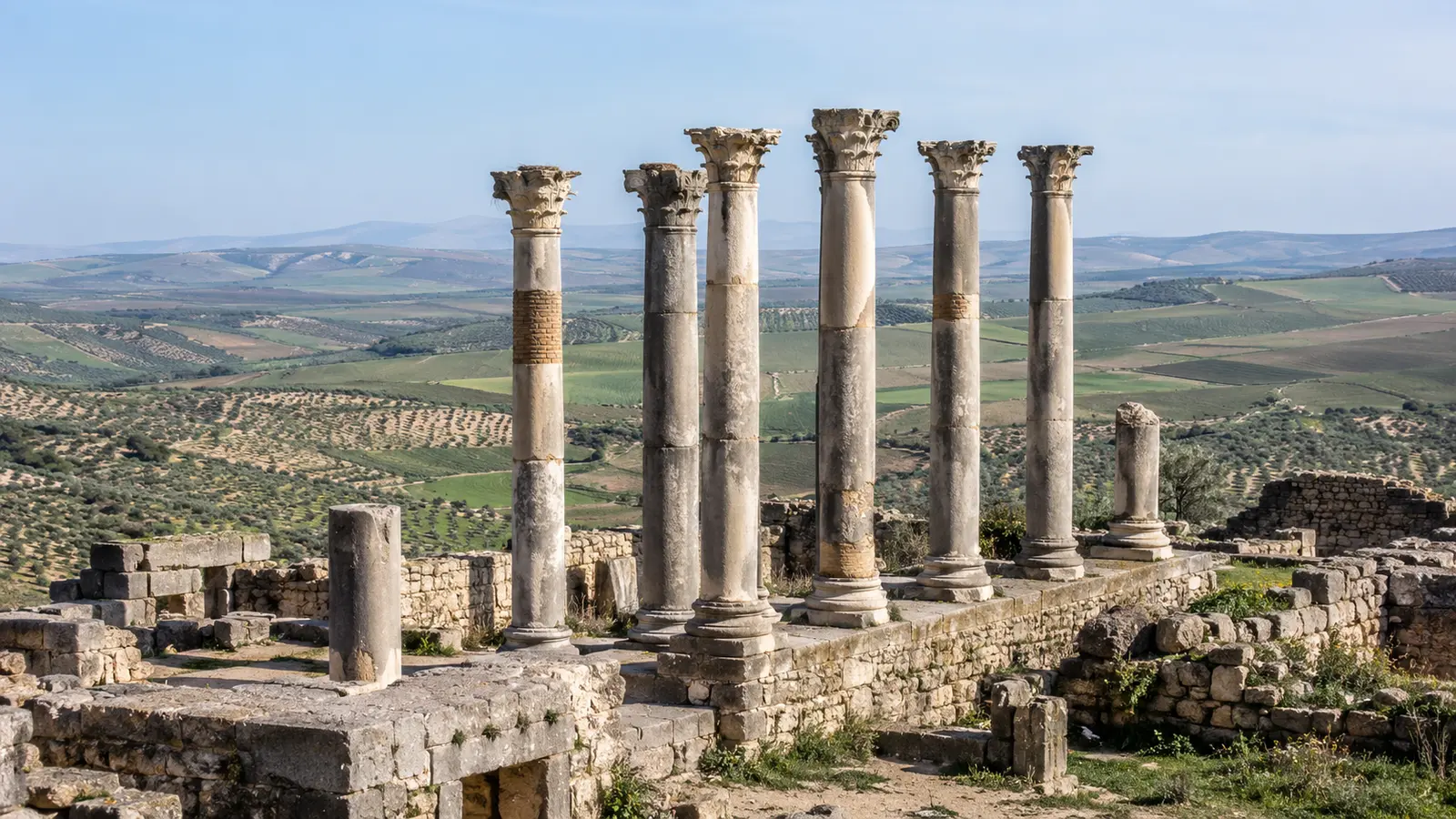
Volubilis preserves the plan and remains of an ancient city, including streets, houses, civic structures, olive-press evidence and mosaics. Use a map or qualified guide to understand how those pieces relate; isolated columns alone tell little. Stay on permitted paths, never touch mosaics, carry sun protection and remember the site is exposed to heat, wind and rain with limited shade.
Mosaics are easiest to understand when their rooms and houses remain part of the explanation. A site plan lets visitors connect the basilica, triumphal arch, domestic areas and productive landscape without marching to whichever column appears next. The exposed terrain makes water, a hat and a slower pace essential, particularly when guide narration keeps a group standing in direct sun.
- Read the site plan before walking
- Protect mosaics by keeping off them
- Carry water and weather protection
- Use interpretation for context
Self-guided or guided
A guide adds value when they can explain urban systems, chronology and the relationship between visible fragments rather than merely reciting names. Agree the route, duration, language and fee before beginning and verify credentials where required. Self-guided visitors should download official context, photograph information panels for personal reference and choose fewer structures for closer observation.
A guide’s most useful contribution may be explaining what is missing: rooflines, water systems, street life and the limits of archaeological certainty. Ask questions and distinguish evidence from reconstruction. If self-guiding, read the UNESCO synthesis before arrival and photograph only the interpretation panels needed for personal reference rather than every fragment.
- Define scope and fee
- Ask for evidence-based interpretation
- Use official panels when self-guided
- Avoid guide claims built on legend alone
Transport from Fes or Rabat
Train plus local road transport offers flexibility but requires negotiating or prearranging the Meknes–Volubilis segment. A private driver buys time control; a group excursion reduces decisions but may compress each stop. Check ONCF live schedules, identify the correct Meknes station and agree whether the road fare includes waiting, Moulay Idriss and the return before the vehicle moves.
A driver should understand whether the day starts at a station, includes luggage, stops in Moulay Idriss and ends in Fes or back in Meknes. Put those points in one written message. Waiting time and parking can affect the quote, so settle them in advance instead of renegotiating beside the ruins with a train approaching.
- Verify station and departure
- Set the complete road scope
- Keep the driver contact
- Hold a backup train option
Moulay Idriss and meal timing
Moulay Idriss Zerhoun is a living pilgrimage town, not simply a scenic stop between ruins. Religious access may be restricted; dress respectfully, avoid intrusive photography and follow local signs. A meal here or in Meknes can break the day, but confirm preparation time and do not let lunch erase Volubilis daylight. Use a planned stop, not a driver’s vague “quick look.”
Visitors can pause in Moulay Idriss for a meal and hillside context while respecting mosque restrictions and private terraces. Do not follow a self-appointed guide into a religious or residential space. If the road schedule is slipping, make this the optional stop; Volubilis and a safe return are the core of the paired day.
- Respect religious boundaries
- Ask before photographing residents
- Schedule lunch with a time limit
- Do not block local lanes
Check current details: UNESCO Archaeological Site of Volubilis · UNESCO — Historic City of Meknes
A clocked plan and contingency
Leave Fes or Rabat early enough to reach Meknes with daylight in reserve. Use the morning for Meknes, arrange lunch and road transfer, visit Volubilis in the cooler practical window available, then return for a train that is not the final service. If road delays grow, drop the extra stop rather than speeding or accepting an unsafe after-dark scramble.
A workable sequence might allow a morning block in Meknes, a prearranged pickup after lunch and two or more daylight hours at Volubilis before the return. Exact times belong in the day’s live schedule, not a permanent article. Carry the next train number and one later alternative, then leave the site early enough to account for road traffic.
- Early rail arrival
- Morning Meknes cluster
- Afternoon Volubilis
- One-train buffer before the last option