
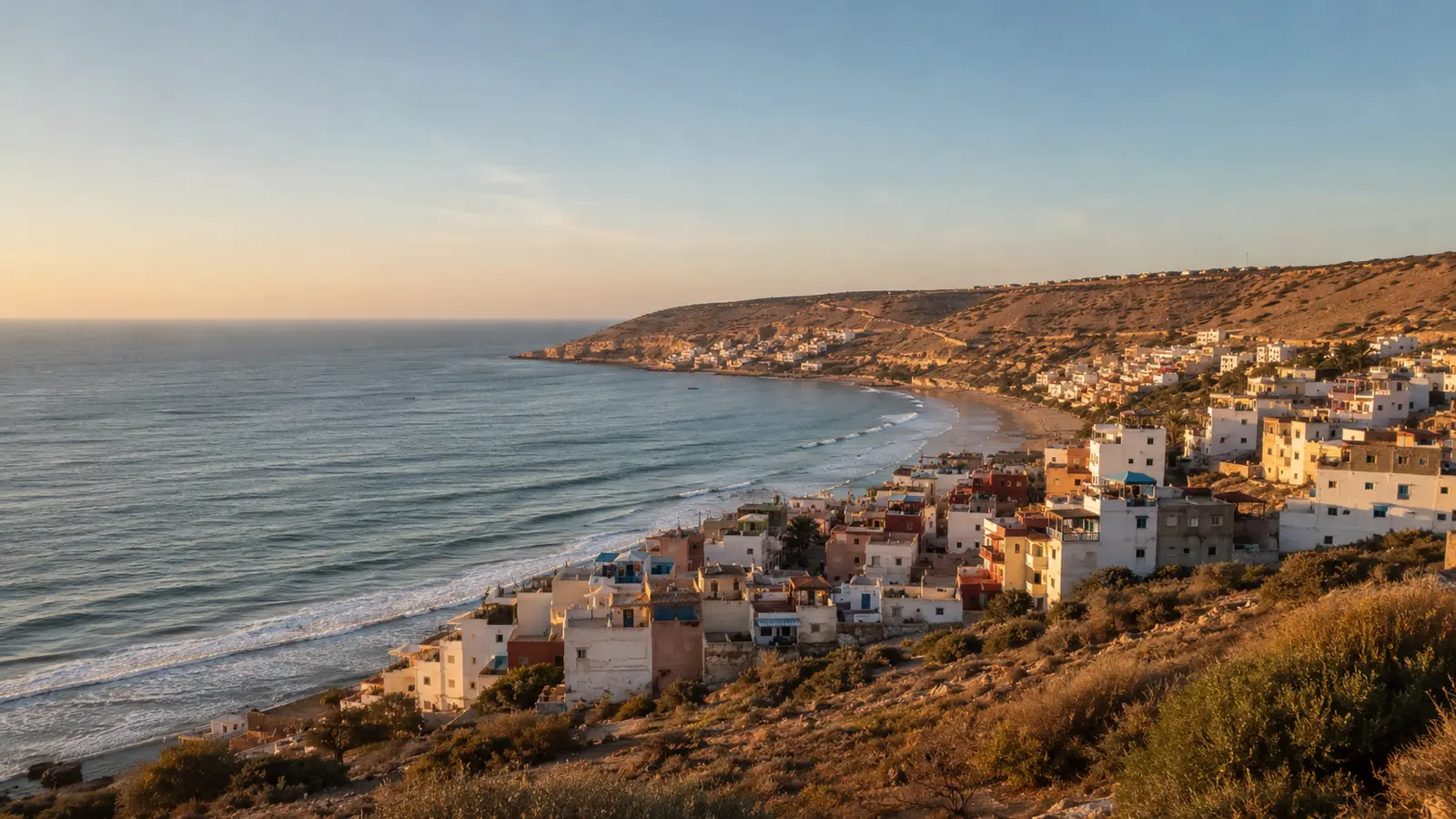
Agadir versus Taghazout
Choose Agadir for urban services, a broad seafront, easier airport logistics and more accommodation variety. Choose Taghazout for a compact café-and-surf rhythm when you are comfortable with hills, road traffic and limited space. Nightlife, quiet and walkability vary by exact address in both places, so inspect the map, access road and recent operational information rather than choosing only by town name.
A traveler working remotely may prefer Agadir’s wider choice of apartments and services, then make planned trips north. A surfer who wants dawn access may prefer Taghazout, provided the exact stay is reachable and quiet enough. Compare grocery access, stairs, road noise and backup connectivity alongside distance to the beach.
- Agadir: city infrastructure and promenade
- Taghazout: smaller village and surf focus
- Check the exact address and road access
- Do not assume every stay is beach-adjacent
Check current details: Official Agadir–Taghazout destination overview · Moroccan National Tourist Office — destinations
Beach and surf geography
A surf break changes with swell direction, tide, wind, season and local hazards; it cannot be permanently labeled “beginner” by an article. Ask a qualified school where today’s lesson will take place and why it suits your ability. Check boards, leashes and transport, disclose injuries and swimming confidence, and follow lifeguard or local restrictions. Non-surfers should assess access and supervision separately.
Reputable surf instruction changes location or cancels when conditions do not fit the group. Ask about instructor-to-student ratio, transport, wetsuit, insurance and rescue arrangements. A “beginner beach” label from an accommodation page is not a substitute for that day’s assessment, and watching skilled surfers at a break does not show that it is appropriate to enter.
- Choose conditions, not reputation
- Use instruction matched to your level
- Follow beach flags and local advice
- Never enter unfamiliar water alone
One practical day in Agadir
Use the promenade and rebuilt city as one cluster, add the kasbah overlook when current access and transport support it, and reserve a separate block for Souk El Had rather than treating the market as a quick photo stop. The 1960 earthquake shaped modern Agadir, so distinguish reconstructed or modern heritage spaces from an intact old medina. Carry sun protection and plan vehicle movement between distant stops.
The modern city is a product of rebuilding after the devastating 1960 earthquake. The hilltop kasbah retains historic significance, while recreated heritage attractions elsewhere should be labeled accurately. At Souk El Had, choose a gate and meeting point because the market is large, and keep purchases manageable for the remaining walk.
- Promenade and city center together
- Kasbah overlook by planned transport
- Souk El Had as a substantial visit
- Keep earthquake history accurate
Taghazout food, cafés and work rhythm
The village supports surf shops, small kitchens, cafés and work-oriented spaces, but seating and internet claims vary. Confirm Wi-Fi, backup power, call etiquette and opening time before planning a full workday. For food, choose focused menus and visible turnover; for fish, clarify price and preparation. Spend beyond a single photogenic café so the day supports more of the local economy.
Coworking claims should be tested with a day pass before committing a week of calls. Ask whether the connection is shared, whether power cuts have a backup and whether speaking on video is acceptable. For cafés, buy regularly and avoid holding a prime table all day. Remote work is easier when it fits the business rather than displacing it.
- Verify work infrastructure
- Respect quiet calls and table turnover
- Choose specialty kitchens
- Walk carefully along the busy road
Paradise Valley and Souss excursions
Images of pools can outlive the water conditions that created them. Before visiting Paradise Valley, verify current water level, access, weather, crowding and environmental restrictions. Never jump into unknown water or leave marked paths for a photograph. A Souss excursion should identify distance, guide, vehicle and community benefit; vague “hidden paradise” marketing is not a safety plan.
Pool depth and cleanliness in Paradise Valley vary with rainfall, stagnation and visitor pressure. Scenic images rarely communicate those conditions. A responsible visit may become a dry hike or be canceled entirely. Ask a current local source about access and never follow someone over a closed barrier because other visitors are visible beyond it.
- Check current water and access
- Do not cliff-jump from social-media cues
- Carry out all waste
- Define transport and return time
Airport, coach and rental-car connections
Agadir Al Massira Airport is the regional air gateway; use ONDA for current flight information and confirm ground transport separately. There is no passenger rail station in Agadir or Taghazout, so onward travel is by coach, car or transfer. A rental car adds flexibility but also parking, road and insurance responsibilities. Avoid driving unfamiliar coastal roads after a late flight.
Taghazout transfers normally pass through Agadir’s road network, so late arrivals should be coordinated with the accommodation. Coach tickets need the correct terminal, while rental-car users should photograph the vehicle condition and understand roadside assistance. If the first coastal drive would be in darkness after a flight, sleeping in Agadir can reduce risk.
- Use ONDA for live airport data
- Use official coach schedules
- Confirm rental insurance and deposit
- Plan a daylight first drive
Check current details: Official Agadir–Taghazout destination overview · Moroccan National Tourist Office — destinations
Argan landscape and cooperative claims
UNESCO recognizes the practices and know-how associated with the argan tree, but that status does not certify every roadside shop. Ask whether a cooperative is legally organized, who owns it, how workers are paid and where production occurs. Genuine demonstrations should allow questions without forcing a purchase. Check ingredient labeling and intended culinary or cosmetic use before buying.
Argan oil intended for eating and oil intended for cosmetics should be clearly labeled and handled accordingly. A credible seller can discuss pressing, ingredients, packaging and storage without relying on a staged grinding demonstration. UNESCO recognition concerns community knowledge and practice; it is not a product seal printed automatically on every bottle.
- Ask about ownership and wages
- Look for clear labeling
- Do not assume “women’s cooperative” is verified
- Pay for quality, not a staged story