
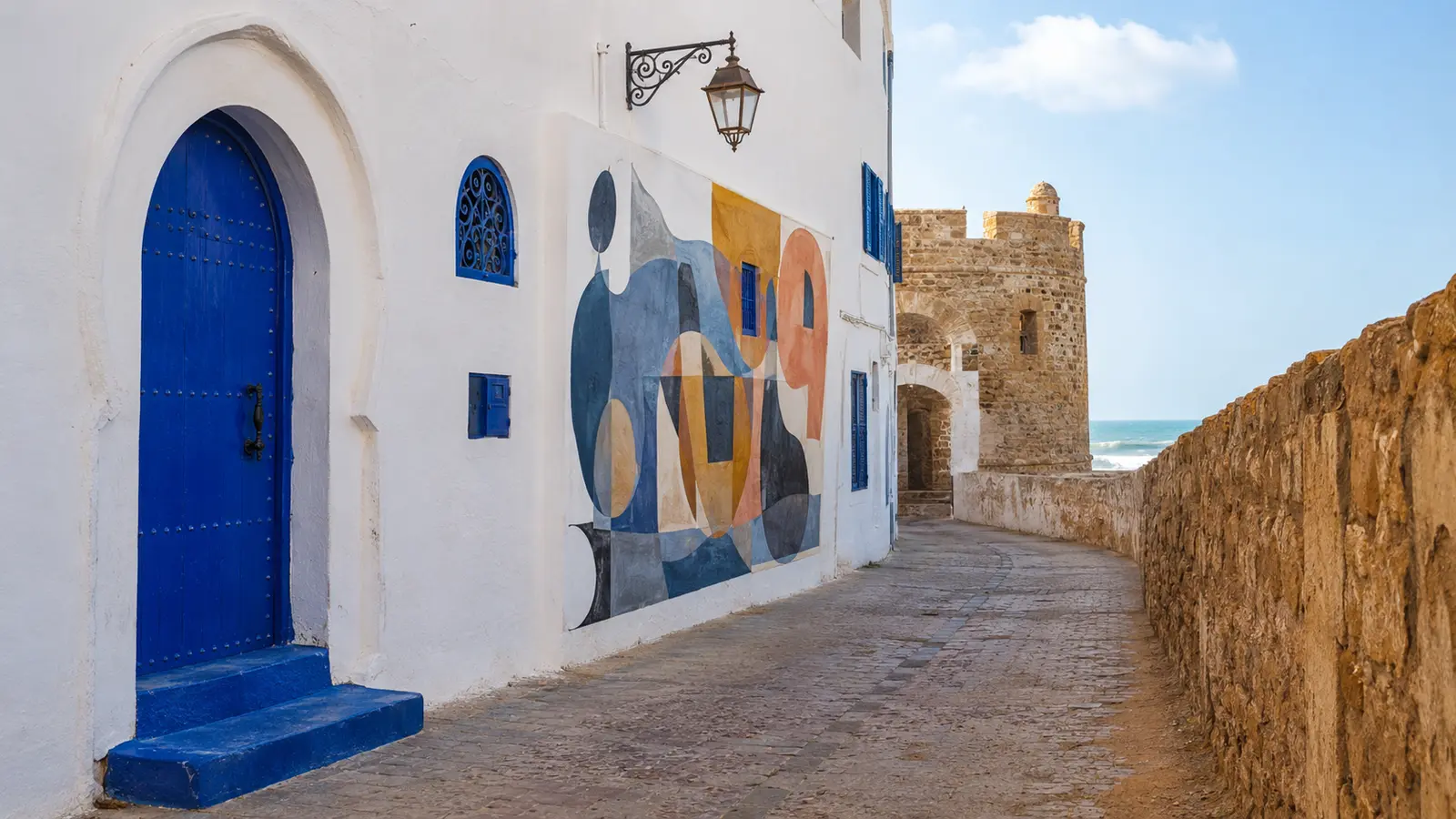
Asilah at a glance
Asilah’s identity combines a walled coastal medina, layers of Portuguese-period fortification and a modern arts culture that becomes especially visible during cultural programming. Summer brings more visitors, traffic and pressure on nearby beaches; shoulder periods can feel quieter but may bring wind or rain. The town works best as a slow loop rather than a sequence of distant monuments.
The strongest first impression comes from contrast: Atlantic light reaches over the walls while compact lanes remain sheltered inside. Give the circuit enough time to observe doors, stonework and the relation between town and sea. Summer events add energy, but Asilah still works outside festival dates; its appeal should not be sold as dependent on a calendar that may change.
- Compact medina for an easy first loop
- Atlantic weather affects the day
- Art and event details need current verification
Check current details: Moroccan National Tourist Office — destinations · ONCF — official rail schedules and booking
The medina loop and rampart edge
Enter through a known gate, follow the white-and-blue lanes toward public rampart viewpoints and use the ocean edge to reorient. Bab Homar can anchor one side of the walk, while the Krikia area is associated with a dramatic sea outlook. Stay behind barriers, do not climb walls for a photograph and remember that many beautiful passages are front doors and working residential routes.
At the Krikia outlook and other rampart edges, salt, wind and uneven surfaces deserve more attention than the camera. Stay on the public side of walls and do not lean equipment over barriers. Returning by a different principal lane creates variety without sending visitors into private cul-de-sacs in search of an invented “secret” viewpoint.
- Save the arrival gate
- Use the sea wall as a geographic anchor
- Keep away from unstable edges
- Make room for residents and carts
Art season and changing murals
Asilah’s contemporary art reputation includes murals that may be repainted, replaced or weathered. Name an artist or installation only after checking current festival or municipal information and recording the observation date. The more durable story is the town’s use of public walls and cultural spaces as a changing exhibition environment. Photograph the work squarely without asking people to pose against private property.
When an artwork can be identified, record the artist, title if supplied, organizer and year from a plaque or current program. When it cannot, describe it simply as a mural seen on the verification date. That distinction prevents an attractive but temporary wall from becoming misinformation copied across travel sites long after it has been repainted.
- Date-stamp named murals
- Credit an artist only when verified
- Do not assume an old image still exists
- Treat public art as part of a changing program
Town beach versus beaches outside town
A central beach is easier to reach without a vehicle, while beaches outside Asilah may require a taxi or car and a firm return arrangement. Facilities, lifeguard coverage, currents, tides and seasonal access can change. Ask locally on the day, observe flags and conditions, and never substitute scenic appearance for a safety assessment. Keep valuables minimal and avoid being stranded after taxis thin out.
Outside-town beaches often involve an informal transport market in high season. Arrange a pickup time and contact, but also understand what you will do if the driver does not return. A beach with fewer buildings may have little shade, water or sanitation. These are trade-offs to plan, not reasons to portray remoteness as automatically superior.
- Check access and return before leaving town
- Follow flags and lifeguard directions
- Carry water and sun protection
- Do not promise facilities from an old review
Where to pause for fish and tea
Rather than chasing one permanent “best” restaurant, choose a place with clear pricing, visible turnover and a menu focused enough to match the kitchen. Ask which fish is available, how it is sold and what preparation is included. A shaded tea stop gives the day breathing room, while a non-rushed lunch prevents the common mistake of treating Asilah as only a backdrop between trains.
Asilah is well suited to a late, unhurried lunch because the historic core is compact. Still, keep the return train or driver in view and ask how long a whole fish or tagine will take. If a kitchen cannot explain the order or price clearly, a bakery, café and market snack can make a more comfortable meal than negotiating after food has been served.
- Confirm whole-fish or portion pricing
- Ask what was prepared that day
- Prefer a calm table over street pressure
- Budget time for the meal, not just ordering
From Tangier by train, taxi or car
ONCF is the source for current rail schedules and fares; check the exact Asilah station and departure on the day. Road travel offers flexibility but introduces parking and summer traffic. A shared or private taxi should be agreed clearly before departure. Whatever the mode, choose a return earlier than the last possible connection and retain a screenshot of the schedule in case mobile data fails.
Rail is attractive because it avoids parking, but the station is not the medina gate; include the local transfer or walk in the day. Drivers should use legal parking outside the tightest lanes. On peak summer weekends, road congestion can erase the apparent flexibility of a car, making a confirmed train the calmer choice.
- Check live ONCF information
- Confirm taxi terms before moving
- Save the station or pickup point
- Protect a realistic return buffer
Check current details: Moroccan National Tourist Office — destinations · ONCF — official rail schedules and booking
Half-day, full-day and overnight versions
A half-day suits travelers focused on the medina loop and one café. A full day allows a long lunch, art spaces and a beach only when transport is simple. An overnight adds evening and morning quiet, especially around cultural events, but should not be booked solely on an assumption that a festival is running. Verify dates and accommodation access before choosing the longer version.
For an overnight, choose a stay by noise, stairs, vehicle access and check-in arrangements rather than décor alone. Evening inside the walls can be quiet outside event dates, while festival periods may bring sound and restricted access. Ask directly about those conditions, then choose a departure late enough to enjoy breakfast without sacrificing the next connection.
- Half-day: medina and viewpoint
- Full day: add lunch and one coastal activity
- Overnight: useful for confirmed events or a slower pace