
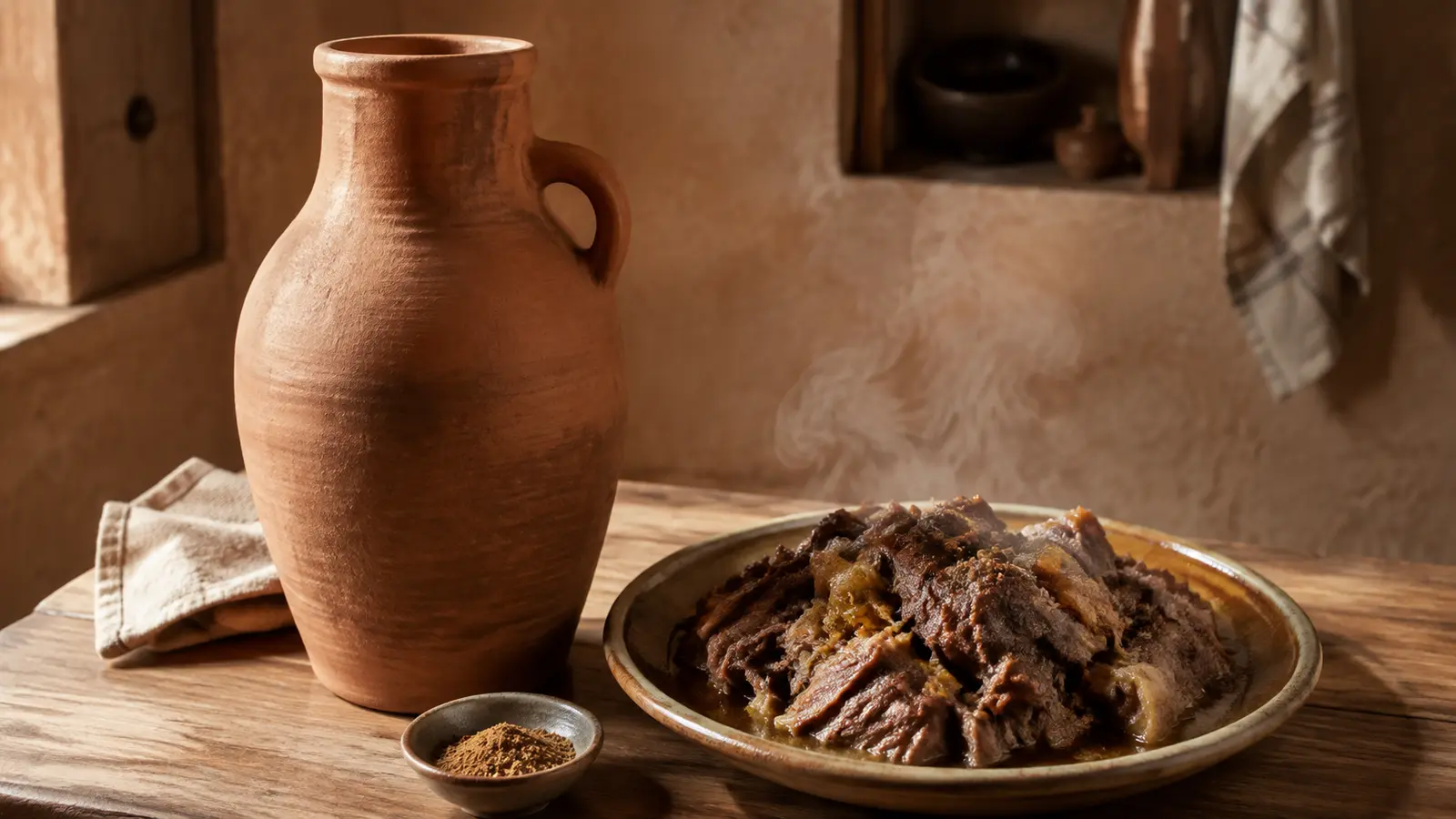
Tanjia the vessel and tanjia the dish: a Marrakech-specific distinction.
The word tanjia names the amphora-like vessel and the meat cooked inside it; it should not be confused with tagine, the broad dish with a conical lid. Tanjia is closely tied to Marrakech and to a method in which a sealed jar spends hours in gentle communal heat.
The narrow vessel limits evaporation and encourages the lamb to cook in its own juices and fat. In a Dutch oven, parchment beneath the lid reduces the venting gap. The result is an adaptation with comparable concentration, not a claim that a household oven duplicates a furnace.
- Vocabulary check: a restaurant serving tanjia from a tagine-shaped dish may still be serving the meat preparation; the cooking vessel and presentation vessel need not be identical.
Check current details: Moroccan National Tourist Office — food and drink
Traditional communal-oven context and what a home adaptation cannot reproduce exactly.
Traditional accounts often describe jars carried to a hammam furnace or neighborhood oven and collected later. That system uses retained heat and local knowledge of the fire. Visitors should not assume any jar or public oven accepts outside food; ask locally and respect current operating rules.
At home, safety is more predictable with a thermostatically controlled oven and a thermometer. This recipe uses 165°C/325°F, rather than an extremely low temperature that might leave a large cold mass warming too slowly.
- Context check: a home method should be judged on tenderness and seasoning, not promoted as an exact recreation of a hammam-furnace schedule that was never used.
Meat, smen, preserved lemon, garlic, cumin and saffron/turmeric balance.
Shoulder provides collagen and fat for the long cook. Smen adds an aged, savory note but can dominate, so one tablespoon is enough; unsalted butter is a gentler substitute. Preserved-lemon rind supplies floral salt, garlic provides depth, and cumin is the recognizable central spice.
Saffron can be bloomed in warm water, while turmeric is a practical color supplement. This is not a ras el hanout-heavy dish. Taste salt only after cooking because preserved lemon and smen vary significantly.
- Salt check: rinse preserved lemon and taste smen separately before measuring added salt; both commercial and household products can vary widely.
Sealing the vessel or covered Dutch-oven alternative.
Coat the lamb thoroughly, put it into a 4-quart Dutch oven and add only 120 milliliters water. Press parchment directly beneath the lid, then cover tightly. Foil may be used between pot and lid, but keep it away from direct flame and do not seal an unknown clay jar with improvised materials.
The pot should be no more than two-thirds full so heat can circulate. A wide, oversized pot encourages evaporation; if that is all you have, check once after two hours and add a small amount of hot water only if the bottom is dry.
- Pot-size check: the lamb should fit snugly in one or two layers, with enough headroom for steam but little empty surface for evaporation.
Low-temperature cooking, doneness and rendered-fat management.
Cook until the lamb yields easily to a fork and can be separated with light pressure, usually three to three and a half hours. The center of the meat must exceed the safe minimum for whole lamb cuts; braised shoulder normally travels well beyond that point as collagen softens.
Lift cooked meat to a warm plate and let the liquid settle. Spoon off excess clear fat, then reduce the remaining juices briefly on the stovetop if watery. Do not discard all fat: a small amount carries the cumin and saffron aroma.
- Doneness check: shoulder needs time beyond reaching 63°C/145°F plus the official three-minute rest to soften collagen; stop only when both safe temperature and fork tenderness are achieved.
Serving with bread, salt correction and rest time.
Rest the meat for 15 minutes before pulling it into large serving pieces. Taste the reduced juices and correct salt only now. If the preserved lemon is forceful, add hot water by the tablespoon; if the sauce is heavy, a teaspoon of fresh lemon juice can brighten it.
Serve with khobz and simple salads that cut the richness. Tanjia is typically about the meat, so avoid burying it beneath elaborate garnishes. A little cumin at the table is more fitting than a sweet sauce.
- Serving check: skim enough fat that sauce tastes clean when warm, remembering that chilled fat seems firmer and more obvious than it will at the table.
Food-safety notes for long low-temperature cooking.
Long cooking does not make unsafe handling harmless. Thaw lamb in the refrigerator, keep it chilled while seasoning, use clean utensils, and get the covered pot promptly into a fully heated oven. Check doneness with a thermometer rather than tasting undercooked meat.
Refrigerate leftovers in shallow containers within two hours and use within three to four days. Reheat with a spoonful of reserved juices until steaming. If cooking in clay, transfer leftovers before chilling; temperature cycling a clay vessel increases cracking risk.
- Cooling check: remove meat from a large heat-retaining pot and divide it with juices among shallow containers rather than cooling the full Dutch oven on the counter.
Check current details: Morocco food safety authority — ONSSA