
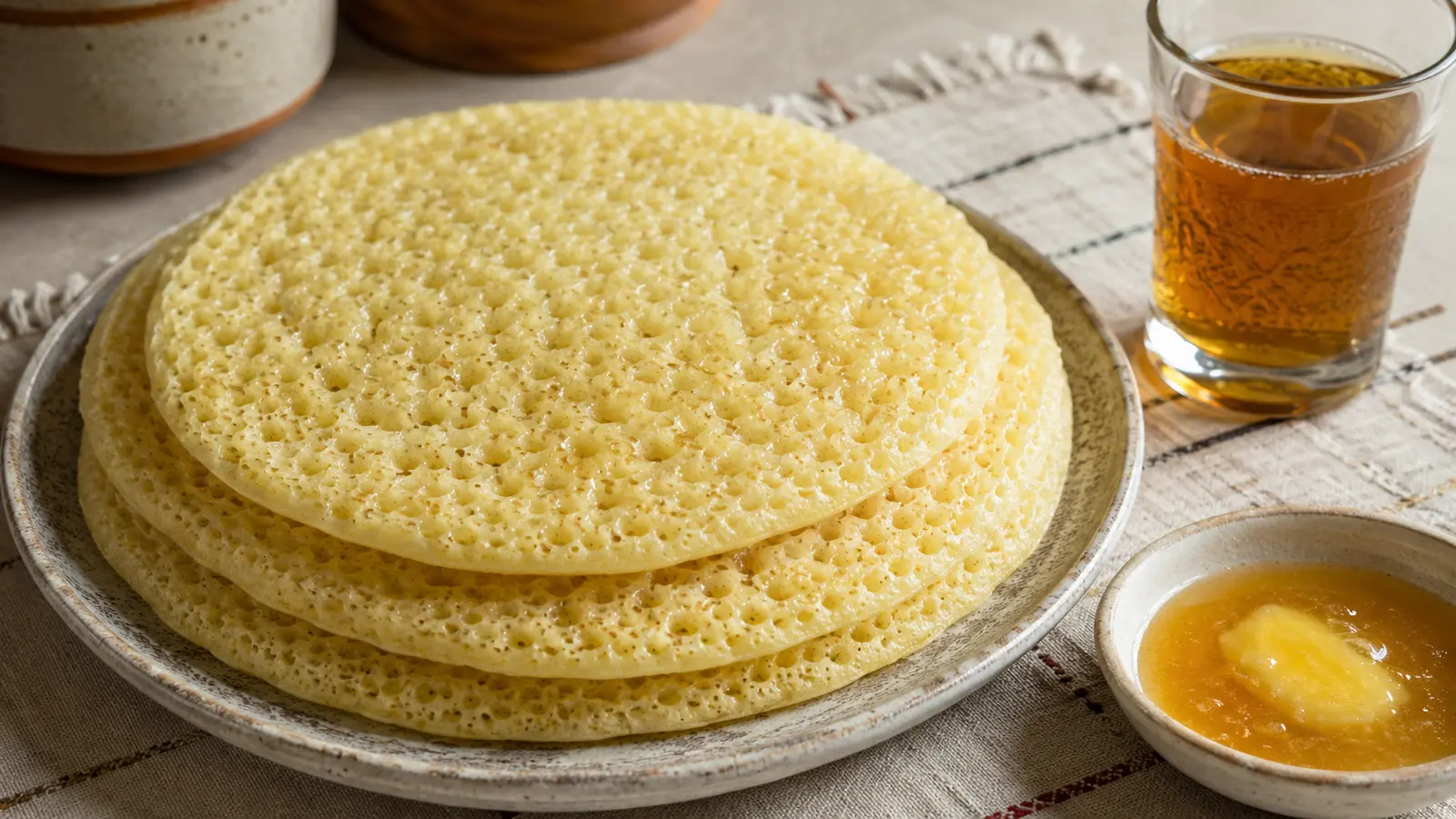
Baghrir texture: why semolina, hydration and fermentation create the holes.
Fine semolina provides the characteristic tender, slightly sandy crumb, while a smaller amount of flour gives enough structure to hold open holes. High hydration lets bubbles rise; yeast creates gas and aroma; baking powder reinforces the final burst when batter meets heat.
The batter must remain pourable like light cream. If it thickens during the batch, the later pancakes form fewer holes. Stir in cool water one tablespoon at a time rather than guessing with a large pour.
- Bubble model: fermentation creates gas, but thin batter and bottom-up cooking create the path that lets those bubbles open visibly at the surface.
- Serving plan: make the honey-butter while the final pancakes cook, then warm the full stack briefly so every guest receives a tender rather than dried surface.
Check current details: Moroccan National Tourist Office — food and drink
Ingredient selection and blender versus whisk methods.
Use fine, not coarse, semolina. Instant yeast disperses easily, while active dry yeast should first dissolve in some measured warm water. Water should feel warm, never hot enough to damage yeast. Weighing semolina gives more repeatable hydration than cups.
A blender breaks up lumps and aerates the batter quickly. A whisk works if dry ingredients are sifted and the mixture is beaten vigorously, but the rest may need longer and the holes may be less uniform.
- Ingredient cue: fine semolina should feel closer to flour than cornmeal; coarse grains absorb unevenly and leave a gritty center in this quick batter.
- Leavener check: test baking powder in hot water and yeast in warm water when packages have been open for months; inactive ingredients waste the entire measured batter.
Batter rest, bubbles and readiness cues.
After blending, cover loosely and rest until a light foam forms and the volume increases slightly, usually 20 to 30 minutes in a warm room. A sharp fermented aroma and collapsing foam indicate the batter has gone too far.
Stir gently before the first pancake. If all the foam is beaten out, wait five minutes for bubbles to recover. The test pancake is ready to judge when holes open across its center, not only around the rim.
- Readiness cue: the batter smells lightly yeasty and carries small bubbles throughout, not just a thick raft of foam floating above still liquid.
- Room-temperature adjustment: in a cold kitchen, extend the rest rather than increasing yeast; in high heat, inspect at 15 minutes so the foam does not peak and collapse.
Pan temperature and cooking one side without browning the top.
Use a clean nonstick pan over medium-low heat and pour batter into the center without swirling. The circle spreads by itself. Do not grease heavily; oil fills surface holes and fries the base. Wipe with a barely oiled cloth only if the pan requires it.
Cook until no wet batter remains on top and the underside is pale gold, about two minutes. Slide out without flipping. Cool the pan briefly under its base—not with water inside—between pancakes if holes stop forming from accumulated heat.
- Readiness cue: the batter smells lightly yeasty and carries small bubbles throughout, not just a thick raft of foam floating above still liquid.
Troubleshooting closed surfaces, gummy centers and uneven holes.
A closed surface usually means batter too thick, pan too hot or baking powder no longer active. A gummy center means the pancake is too thick or removed before the matte finish reaches the center. Uneven holes point to a tilted pan or batter poured off-center.
Change one variable at a time after the test pancake. Add a tablespoon of water for thickness, lower heat for premature setting, or replace old leavening before remaking a batch. More yeast cannot rescue inactive baking powder immediately.
- Pan reset: after several pancakes, set the dry pan base on a folded cool damp towel for a few seconds, then return it to heat; never pour water into the pan.
Honey-butter sauce and lower-sugar toppings.
A classic topping melts butter with honey and spoons it over the porous surface, where it collects in the holes. Use equal weights for a rich sauce or two parts honey to one part butter for more sweetness. Warm gently and do not boil.
For less sugar, serve plain yogurt, soft cheese, fruit or a light brush of olive oil. Baghrir itself is unsweetened, so it can support savory toppings as long as they are not so wet that the pancake disintegrates.
- Troubleshooting record: photograph the test pancake and note batter weight, rest time and burner setting, which makes a second batch easier to correct than memory alone.
Holding, freezing and reheating without sticking.
Cool pancakes in a single layer before stacking; warm surfaces stick and compress the holes. Once cool, separate with parchment. Refrigerate up to three days or freeze for up to two months for best texture.
Reheat briefly in a covered skillet or microwave beneath a barely damp towel. Avoid toasting until crisp; baghrir should remain tender. Warm honey-butter separately and add only at service.
- Topping control: spoon honey-butter over each serving rather than soaking the full stack so leftovers can be refrigerated without becoming sticky and compressed.