
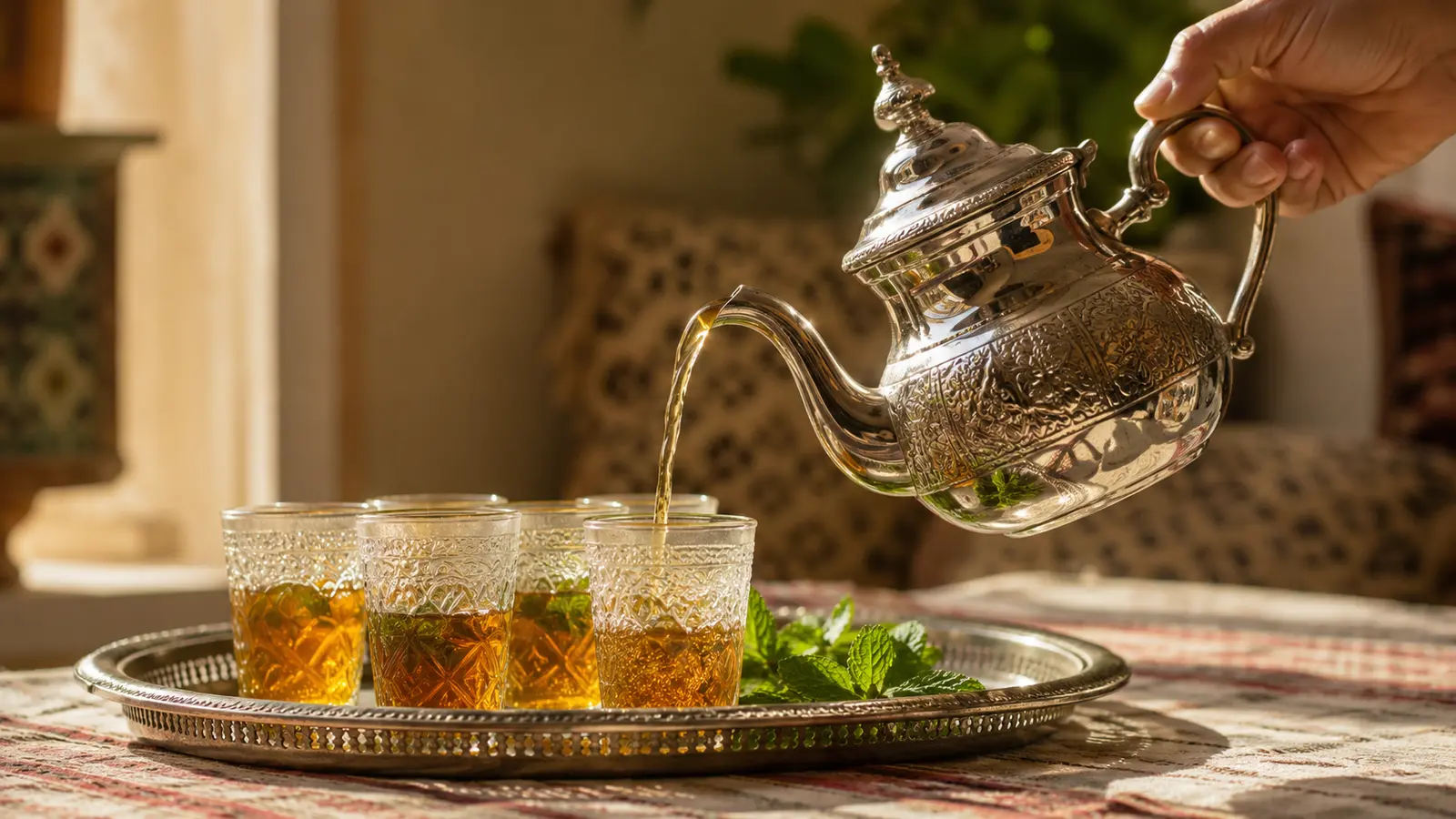
Tea as hospitality rather than spectacle: when, how and why it is offered.
Tea may appear after a meal, during a business conversation, at a family visit or whenever someone pauses long enough to offer welcome. Accepting at least a small glass is often the easiest way to participate, while hosts generally understand medical, dietary or personal limits when explained politely.
The ritual is not frozen. Some homes make a very sweet pot, cafés may serve sugar separately, and quick everyday tea can be less elaborate. Treat the person serving you as the authority on that moment rather than correcting them with a travel-book script.
- Hospitality cue: a polite request for little or no sugar is clearer before brewing than leaving several full glasses untouched after the host has mixed the pot.
Check current details: Moroccan National Tourist Office — food and drink
Choosing gunpowder green tea, mint varieties, water and sugar level.
Gunpowder green tea consists of tightly rolled leaves that open in hot water. Look for a fresh grassy aroma and intact pellets rather than stale dust. Spearmint is common; rinse bunches well, remove dark leaves and keep tender stems because they carry aroma.
Use freshly drawn water with no strong chlorine odor. A starting ratio is 8 grams tea and 30 grams mint per liter. Traditional sugar levels can be high; 30 to 60 grams per liter gives a moderate range, while unsweetened tea can be poured before sugar is added.
- Mint cue: stems should snap and leaves smell vivid when rubbed; blackened edges, slime or an ammonia-like odor indicate a bunch that should be discarded.
Rinsing the leaves and preserving the first infusion: document one tested household method.
Warm the metal pot with hot water and discard it. Add tea, pour in about 100 milliliters boiling water, swirl ten seconds and discard this cloudy rinse. Then add another 100 milliliters, steep one minute and reserve that clear amber infusion—the aromatic “spirit” in this method.
These actions are a documented household-style technique, not the only Moroccan rule. Some makers discard more than one rinse or retain a different fraction. Consistency matters more than insisting on one vocabulary.
- Rinse distinction: the first quick rinse is discarded, while the next short aromatic infusion is retained in this method; label the vessels during a demonstration.
Brewing, mixing in the pot and avoiding boiled-mint bitterness.
Return the reserved infusion to the pot, add remaining hot water and sugar, and bring the metal teapot just to a brief boil on a compatible low burner. Remove from heat before adding mint so prolonged boiling does not drive the herb toward bitterness and dull color.
Steep mint three to five minutes. To mix, pour one glass and return it to the pot two or three times. Taste carefully; add sugar in small increments because removing dissolved sugar is impossible.
- Bitterness cue: reduce mint contact time before reducing green-tea quantity, because over-boiled mint and over-steeped tea create different but compounding bitter notes.
Pouring height, foam and what is functional versus performative.
A higher pour aerates the tea, cools it slightly and creates surface foam. Those are practical effects, but height is not a measure of hospitality. Begin close to the glass and raise the pot only as control allows; hot tea spilled from a theatrical pour benefits nobody.
Fill small heat-safe glasses no more than two-thirds so they can be held near the rim. Keep the spout directed away from people while carrying the pot, and protect delicate tables from the hot metal base.
- Pouring cue: practice with cool water before raising a metal pot; a clean stream and safe landing matter more than maximum height.
Regional and seasonal herb variations.
In cooler months, households may combine mint with absinthe-like sheba, verbena or other regional herbs. Each changes bitterness and aroma, and names vary. Use only culinary herbs you can identify confidently; a market bundle is not automatic proof that every plant is suitable for everyone.
Fresh orange blossom is sometimes associated with special preparations, while pine nuts appear in some northern service traditions. Describe these as local or household variations rather than ingredients required for a pot to be Moroccan.
- Variation practice: add unfamiliar herbs to one glass or a small test pot first, preserving the main batch for guests who expect mint.
Serving etiquette, lower-sugar adaptation and pastry pairings.
Offer the first glass and let the host manage refills. If reducing sugar, put cubes or a small bowl on the tray. Msemen, baghrir, almonds and modestly sweet biscuits all work because their textures stand up to hot tea without adding another aromatic competition.
Tea is best made fresh; mint darkens and becomes bitter as it sits. Discard a pot left at room temperature for hours, rinse the teapot promptly and dry it open. Continue exploring breakfast traditions through the msemen and baghrir guides rather than treating tea as a stand-alone spectacle.
- Pairing quantity: two small pieces of bread or pastry per person usually support the tea without turning a pause for hospitality into an unplanned full meal.