
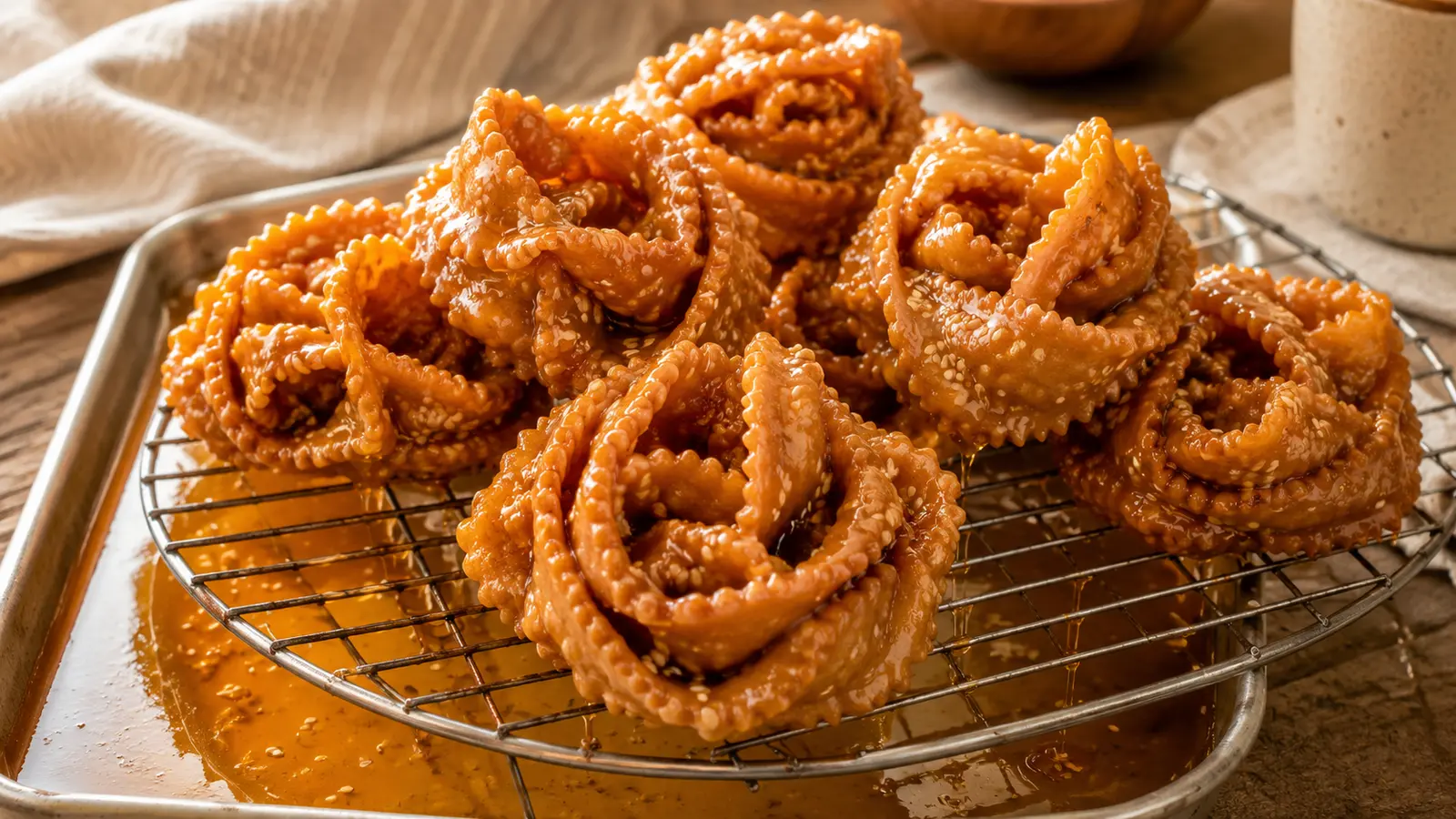
Chebakia in context: a festive pastry often served during Ramadan, with household shapes and spice profiles acknowledged.
Chebakia often appears during Ramadan because its honeyed richness complements the savory acidity of harira at iftar. It is also prepared for celebrations and family visits. That context describes a common use, not a rule that restricts the pastry to one month or one table arrangement.
Some families build intricate roses with many interlaced strips, while others make a simpler folded lattice. Spice intensity, sesame quantity and honey-soak time also change. The useful standard is structural: a crisp, cooked-through shell with open spaces that accepts a thin honey coating.
- Plan chebakia as a multi-stage pastry: toast and grind, mix and rest, shape the full batch, fry, soak, then drain completely.
Check current details: Moroccan National Tourist Office — food and drink
Building the sesame-spice dough: flour, toasted sesame, anise, cinnamon, saffron and orange blossom water.
Toast sesame only until fragrant and pale gold, then cool before grinding. Ground sesame gives the dough its nutty depth; whole garnish seeds provide texture. Anise, cinnamon and saffron should remain distinct but gentle enough that orange blossom and honey can still be recognized.
Flour supplies structure, while olive oil and melted butter shorten the crumb. Vinegar contributes tenderness and a slight balancing acidity. Orange blossom water varies greatly in strength, so smell it before measuring and never replace it with perfume or a cosmetic product.
- Grind sesame to a fine meal that still feels dry; processing until it becomes paste changes both hydration and frying behavior.
Mixing, kneading and resting for a thin sheet that folds without cracking.
Mix dry ingredients evenly before adding egg, fats, vinegar, orange blossom water and saffron infusion. Add warm water gradually. The target is a firm but pliable dough—softer than pasta dough, firmer than bread dough—that can roll thin without sticking.
Knead until the surface becomes smooth, then rest covered for 30 minutes. The rest hydrates flour and lets the dough relax. If it cracks when rolled, knead in water one teaspoon at a time; if it smears and sticks, chill briefly rather than burying it in extra flour.
- Divide into four covered portions so only a small sheet is exposed while the remaining dough stays supple.
Cutting and weaving the flower shape one pastry at a time.
Roll one portion to about 2 millimeters thick. Cut 10-by-12-centimeter rectangles, then make four parallel interior slits lengthwise while leaving a solid border. Lift alternating strips over one finger, pinch the two short ends together and turn the joined center through the lattice to open a flower.
The first few pastries may look uneven, but matching thickness matters more than perfect symmetry. Pinch the joint firmly so it survives frying and place finished pieces under a dry cloth in a single layer. Re-roll scraps once; repeated rolling makes them tough.
- Keep the center open enough for hot oil to circulate; compressed knots brown outside while raw dough hides inside.
Frying temperature, batch size and observable crispness cues.
Heat a deep, heavy pot with enough neutral oil for the pastries to float. Hold 170 to 175°C/338 to 347°F. Add only four or five pieces at a time, allowing the temperature to recover between batches, and turn them so every folded edge colors evenly.
Chebakia is ready for honey when it is a deep even gold, bubbles around it have slowed and the folds feel crisp under tongs. Pale pastry becomes soft in honey; very dark pastry tastes bitter. Drain for only a few seconds before transferring to the warm honey.
- Keep pot handles turned inward, lower pastries away from the body and never add water near hot oil.
Warming the honey, soaking without sogginess and finishing with sesame.
Warm honey gently with orange blossom water until fluid, around 50 to 60°C/122 to 140°F; it should never boil. Submerge hot pastries for 45 to 60 seconds, turn once, then lift to a rack set over a tray. Longer soaking gives a softer, heavier result.
Scatter toasted sesame while the surface is still tacky. Let the pastries drain and cool in a single layer before stacking. Honey returned from the draining tray can be strained and refrigerated for another cooked use only if it remained clean and free of crumbs or oil contamination.
- A finished pastry should shine in a thin coat while its lattice remains visible and crisp at the narrow edges.
Make-ahead workflow, serving with harira or tea, and storage.
Toast sesame and mix dry ingredients a day ahead, or shape pastries several hours before frying if they remain covered and cool. Do not leave egg-containing raw dough at room temperature through a long day. For a Ramadan meal, fry early enough that oil aromas clear before soup is served.
Serve one or two pieces with harira or Moroccan mint tea rather than treating the honey coating as a reason for a large portion. Cool completely before storing. Keep airtight in a cool dry place for up to three days for best texture, or refrigerate up to one week and return briefly to room temperature.
- Do not freeze honey-soaked chebakia if crispness matters; freeze shaped raw pieces instead, then thaw in the refrigerator before frying.
Check current details: Agricultural Development Agency — Moroccan terroir products · Morocco food safety authority — ONSSA