
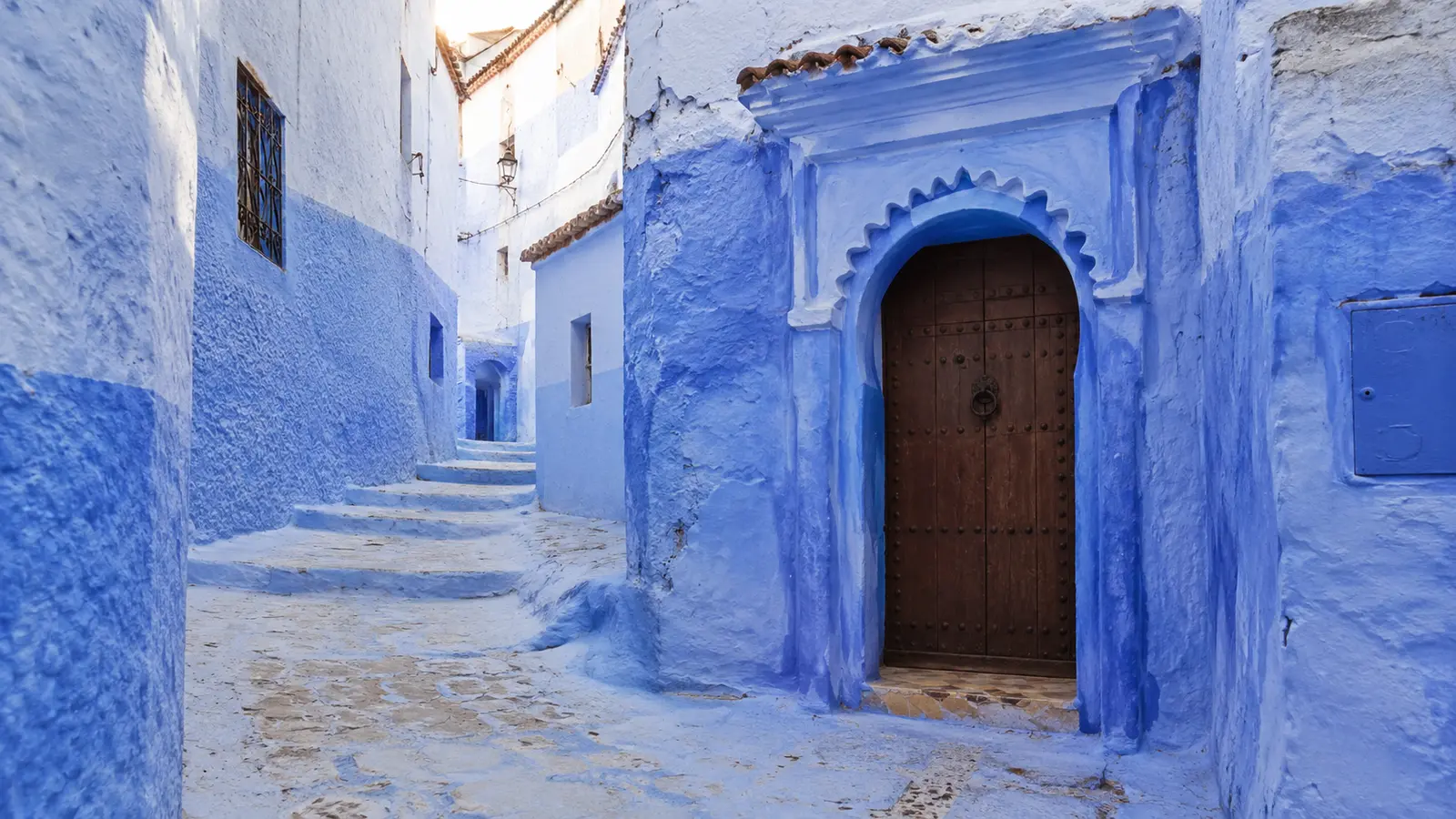
Chefchaouen in its Rif setting
Chefchaouen climbs a mountainside beneath Rif peaks. Its medina is smaller and more immediately legible than Fes or Marrakech, but steep lanes slow walking and rain can make polished surfaces slippery. A day trip covers the central loop; one night adds a calm evening and early morning; two nights make sense if you want a weather-dependent walk rather than merely more photographs.
For many visitors, the best overnight pattern is afternoon arrival, an early dinner and evening circuit, followed by a dawn or breakfast-time walk before checkout. That schedule shifts the medina away from the busiest excursion window without claiming the town becomes empty. It also leaves a second chance for the viewpoint if clouds or rain make the first evening unsuitable.
- Day trip for the central medina
- One night for quieter lanes and sunset
- Two nights for a hike with weather flexibility
Check current details: Official Chefchaouen destination overview · Moroccan National Tourist Office — rural heritage
A low-backtracking medina walk
Enter through Bab el Ain, follow the commercial spine toward Plaza Uta el-Hammam and use the kasbah exterior as an orientation point. Continue gradually toward Ras el-Maa, where water and the town edge meet, instead of repeatedly climbing the same lanes. Side streets are best explored in short loops that return to a known axis; offline mapping helps when blue walls make junctions feel similar.
The lanes beyond the plaza are for exploration, but not every uphill turn improves the route. When a passage narrows into a residential dead end, turn around instead of treating a doorstep as a viewing platform. A saved pin at Bab el Ain or the accommodation is more dependable than following anyone who announces that a familiar street is closed.
- Save the starting gate offline
- Keep the plaza as your reset point
- Climb slowly and share narrow passages
- Leave private dead ends promptly
Viewpoints and short walks
The Spanish Mosque route is a popular ascent beyond Ras el-Maa. It is still a real hillside walk: wear shoes with grip, carry water and turn back when rain, heat, darkness or trail conditions make the plan poor. Aim to descend before losing usable light. Longer Rif hikes require a different level of preparation, current local advice and, where appropriate, a qualified local guide.
The Spanish Mosque viewpoint is exposed and its return can be darker than expected after sunset. Start early enough to descend with natural light, especially after rain. Akchour and Talassemtane are separate outdoor plans with transport, trail and weather questions of their own; they should not be appended casually to the town walk because a driver mentions them.
- Check weather before committing
- Carry water even for a short climb
- Do not improvise after dark
- Separate town viewpoints from mountain treks
What the blue architecture can honestly tell us
Chefchaouen’s blue surfaces are continually renewed by residents, businesses and tourism, so they are not a frozen medieval color scheme. Explanations often cite spiritual symbolism, cooling, insects or twentieth-century community practice, but no single slogan adequately accounts for every lane or period. Present the color as an evolving local visual culture and focus on observable details: paint layers, thresholds, drainage and craft.
Color also varies block by block: some walls are intensely painted, others weathered, and doors or steps may carry different shades. That variation is evidence of continuing maintenance, ownership and tourism influence. A careful caption can describe the surface, date and location without claiming that every blue wall has the same religious, practical or historical explanation.
- Avoid repeating an unsupported single-origin story
- Notice functional details beneath the color
- Treat repainting as living practice
- Keep captions factual
Regional food and crafts
Look for fresh bread, simple tagines, goat cheese where genuinely offered, olives and seasonal produce rather than expecting a “blue city” themed menu. In craft shops, ask where an item was made and what material it uses. Compare quality before bargaining, keep the exchange friendly and accept a stated price or walk away without performance. Paying fairly matters more than winning a story about a dramatic discount.
Fresh goat cheese is associated with the north but may not appear at every restaurant or in every season. Ask what is local today, and pair it with bread, olives or a simple meal when available. For textiles, examine weave, fiber, finishing and repairability; “handmade” is a question to investigate, not a guarantee supplied by the setting.
- Ask about origin and material
- Compare several examples before buying
- Do not photograph artisans without permission
- Choose a specialty over an oversized menu
Connections with Tangier, Tetouan and Fes
Chefchaouen has no rail station. Official coaches and shared or private road transport connect it with larger cities, but mountain roads make travel time more variable than distance suggests. Check CTM or the relevant operator for live departures, book high-demand legs early and identify the actual boarding point. For a day trip, protect the last realistic return rather than planning around the final possible vehicle.
Tangier is the simplest base for a first northern circuit, while Tetouan can work as an intermediate stop and Fes involves a longer road leg. Compare the actual departure times before choosing an overnight sequence. If the final coach arrives after the accommodation’s staffed check-in, arrange entry in advance rather than assuming someone will be waiting.
- Verify the operator and boarding location
- Keep a backup departure in mind
- Allow for road and weather delays
- Avoid an unplanned late-night road arrival
Check current details: Official Chefchaouen destination overview · Moroccan National Tourist Office — rural heritage
Photography etiquette in residential lanes
A doorway, child, shopkeeper or person at prayer is not public décor merely because the lane is photogenic. Ask clearly before making a close portrait, accept “no” immediately and never offer sweets or money to children for an image. Use early light to reduce crowd pressure, wait off to one side rather than blocking traffic and prefer architectural frames without identifiable residents.
Wide architectural frames are often stronger than close portraits because they show slope, drainage, thresholds and how the lane functions. If a resident agrees to a photograph, clarify whether sharing online is also acceptable; consent to one image is not necessarily consent to publication. Avoid geotagging a private doorway in a way that sends repeated visitor traffic to it.
- Ask before portraits
- Never enter a threshold for a composition
- Keep tripods out of narrow traffic
- Share the lane with deliveries and residents