
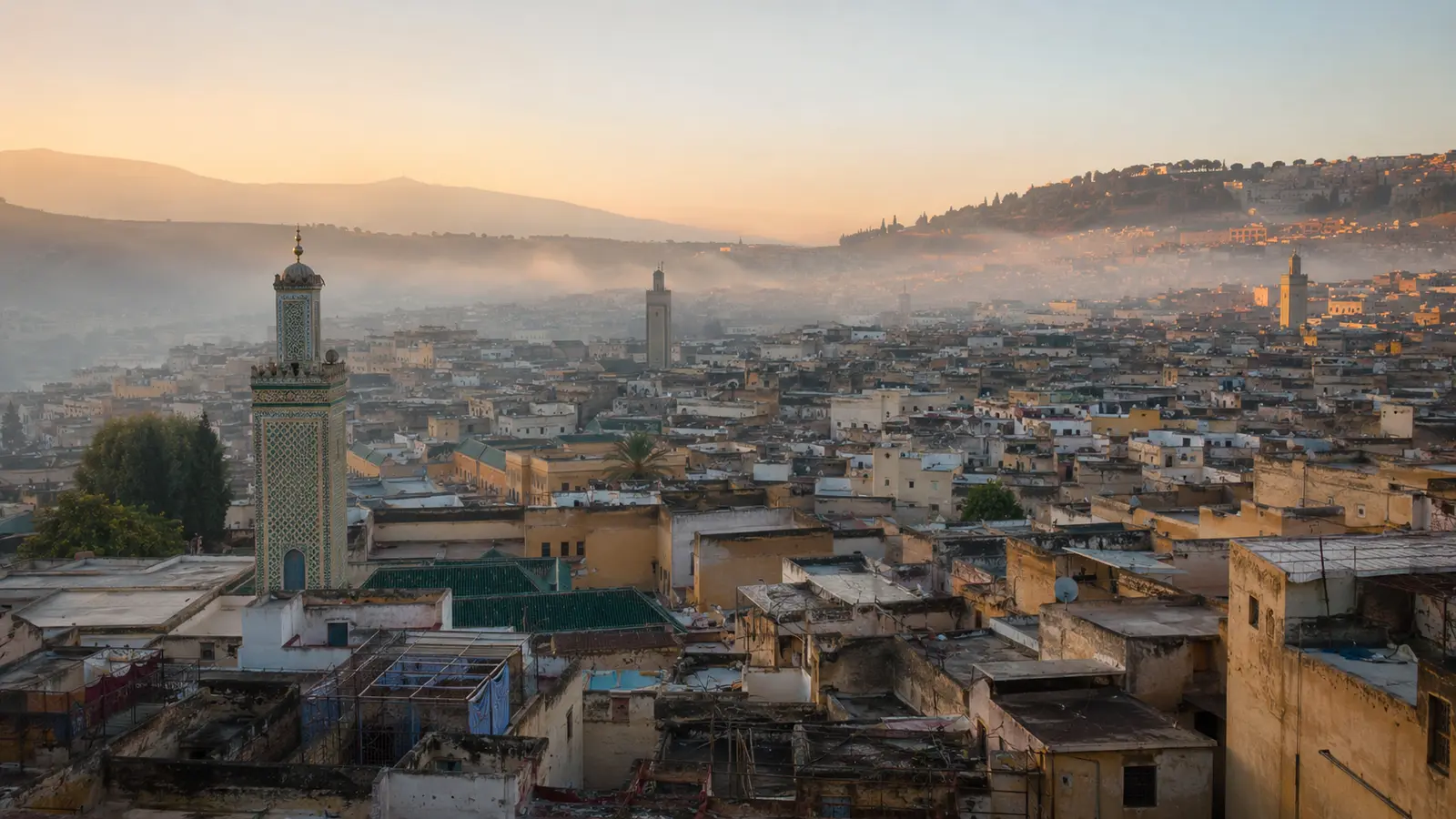
Reading Fes as three urban layers
Fes el-Bali is the oldest walled city and the core of most first-visit walking. Fes el-Jdid, founded later, includes different royal, military and residential histories; the modern Ville Nouvelle is physically separate and useful for rail, broad roads and contemporary services. Choose accommodation and daily transport with these distances in mind rather than assuming “Fes” means the same pedestrian zone.
Accommodation descriptions often blur Fes el-Bali and Fes el-Jdid under the word “medina.” Ask for the nearest gate, walking time from vehicle access and whether stairs are involved. The Ville Nouvelle may be the practical choice for travelers prioritizing elevators and taxis, while a stay inside Fes el-Bali offers atmosphere at the cost of more complicated arrival.
- Fes el-Bali for dense historic fabric
- Fes el-Jdid for later walled-city layers
- Ville Nouvelle for rail and modern services
Check current details: UNESCO Medina of Fez record · Moroccan National Tourist Office — medinas and heritage
UNESCO context and living craftsmanship
UNESCO traces Fes to the ninth century and emphasizes its Marinid-period madrasas, fondouks, palaces, residences, mosques and fountains. Many of those forms remain integrated with commerce and residence. Read a fondouk as infrastructure for trade, a fountain as urban service and a workshop as skilled labor. Religious interiors may restrict non-Muslim access; admire them from permitted areas without pushing past boundaries.
Madrasas and fondouks illustrate education and trade, but access and restoration status can change. Use the UNESCO record to understand why the urban ensemble matters, then consult the responsible venue for entry. Mosques should never be treated as a challenge to visitor restrictions; the exterior, adjoining lane and surrounding craft can be studied without crossing a religious boundary.
- Use official heritage context
- Distinguish public monuments from active religious space
- Pay attention to function as well as decoration
- Respect workshop production
A two-day route by gate and elevation
On day one, enter from a known upper gate or viewpoint and work gradually through a single landmark cluster toward a reliable exit, pausing for one madrasa or museum that is confirmed open. On day two, choose a different gate and focus on food, craft and neighborhood detail rather than repeating the central commercial spine. Save both exits offline and avoid following unsolicited shortcuts.
A first route might run from an upper gate toward a central craft and monument cluster, with the second day focused on food production, neighborhood markets or Fes el-Jdid. That is more resilient than copying a line with twenty stops. If navigation fatigue sets in, leave through the nearest known gate and restart later instead of accepting a stranger’s escalating series of “helpful” detours.
- Start each day with one named gate
- Plan downhill where practical
- Limit each half-day to one cluster
- Keep a fixed meeting point outside the maze
Tanneries without myths or pressure
Terraces around the tanneries offer a view into leather processing, but access commonly passes through shops whose staff may expect a sale or tip. Ask whether viewing is free, whether a guide fee applies and whether any purchase is optional before climbing. Odors vary, and mint is not a safety device. Photograph workers only with permission and avoid romanticizing difficult labor as an unchanged medieval spectacle.
Leather sold around the tanneries varies in material and construction. If buying, inspect seams, lining, hardware, dye transfer and smell, then ask about care and returns. The terrace view does not obligate a purchase, but an agreed viewing fee should be honored. Avoid language suggesting workers perform for visitors; the production continues whether or not a camera is present.
- Clarify viewing terms first
- A purchase is never required unless stated
- Ask before close photographs
- Leave if sales pressure overrides the visit
Food by specialty and time of day
Build the day around functions: a bakery for bread, a soup counter, a grill with visible turnover, a pastry stop and one meal where a smaller menu indicates focus. Medina access complicates deliveries and refrigeration, so use ordinary food-safety judgment. Confirm prices when not posted and ask whether a dish requires advance ordering. A where-to-eat framework ages better than an unsupported permanent ranking.
Some dishes require advance preparation, and a riad dinner may need to be booked earlier in the day. That can provide a calmer meal than searching late in unfamiliar lanes, but confirm menu, dietary needs and total first. For street food, hot food should be hot, raw garnishes deserve ordinary caution and busy turnover is more useful than a viral recommendation from years ago.
- Choose visible turnover
- Look for a clear specialty
- Confirm price and portion
- Reserve family-style dishes when required
When a licensed guide adds value
A qualified guide can connect architecture, guilds and city history while controlling a route that would otherwise consume energy in navigation. Define the duration, language, interests, inclusions, shopping stops and total fee before starting. Make clear if you do not want commission-linked retail. Independent exploration still works when you use a limited route, offline map and the discipline to ignore anyone claiming a public street is closed.
A strong guide brief can ask for architecture and craftsmanship with no shopping, or for a specific artisan visit where introductions are welcome. It should also state mobility needs and the preferred finish gate. If a guide changes the plan for a closure, ask for the reason and alternative; flexibility is useful when it remains transparent.
- Set scope and price in advance
- State your shopping preference
- Ask for official credentials where required
- Keep your own orientation tools
Check current details: UNESCO Medina of Fez record · Moroccan National Tourist Office — medinas and heritage
Arrival, medina transfer and onward travel
ONCF provides live rail information for Fes. A riad inside pedestrian lanes may require a taxi to a gate followed by a walk or porter; request written arrival instructions and agree any porter charge before the luggage moves. Meknes and Volubilis make a logical separate day when transport is arranged. Do not place a non-refundable connection immediately after a deep medina walk with no transfer buffer.
Send luggage instructions to every traveler before arrival. A screenshot of the gate, host number and final walking route helps when data fails, while a small overnight bag reduces porter dependence. For Volubilis, plan the road segment separately from the train to Meknes; rail does not reach the archaeological site itself.
- Request the exact gate from your accommodation
- Keep the address in Arabic or French
- Agree porter or taxi terms
- Use official rail times for onward travel