
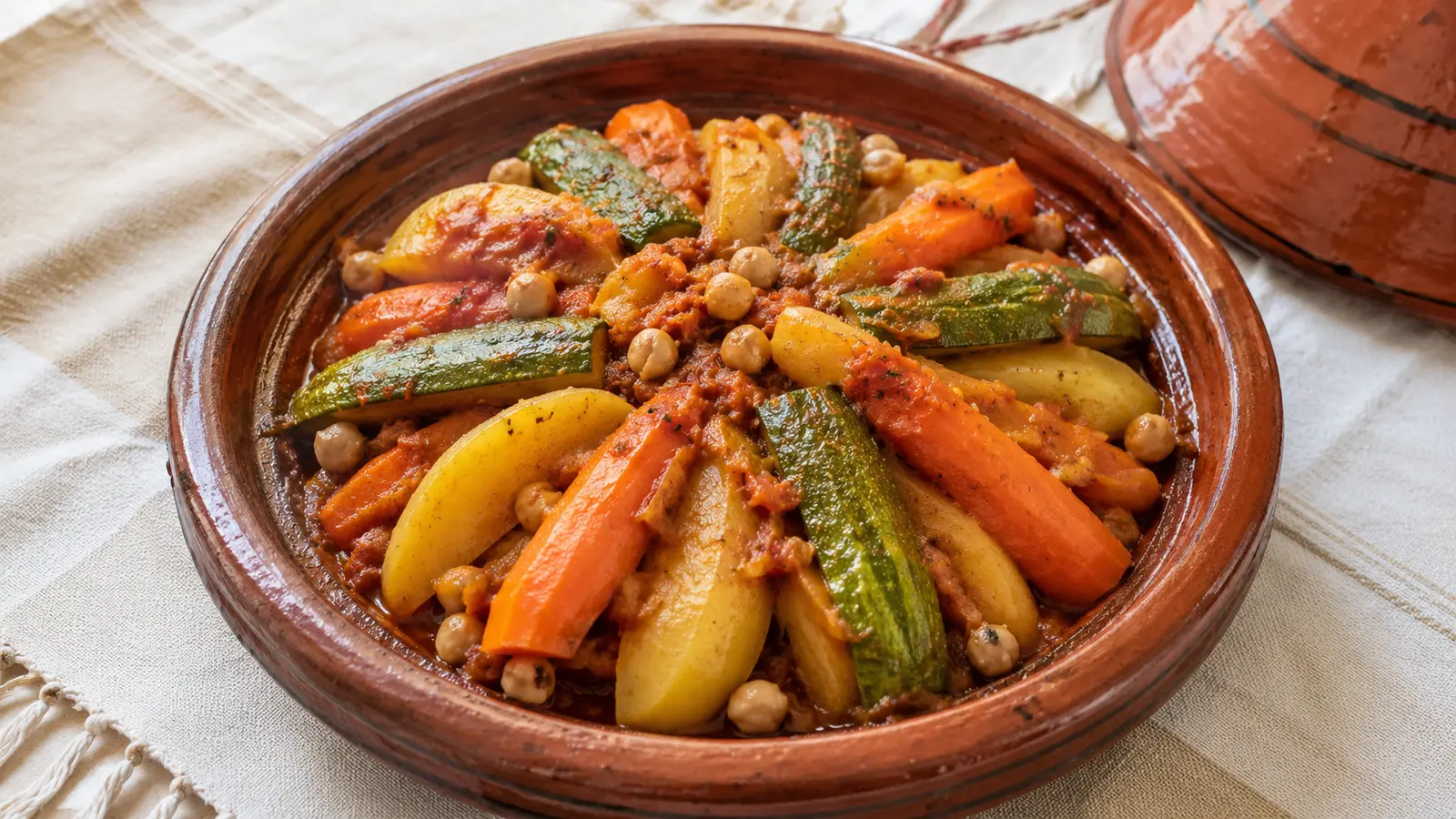
Building flavor without meat: onion bed, chermoula-like seasoning and controlled moisture.
Without meat drippings, flavor begins with grated onion, tomato and a chermoula-like mix of garlic, cilantro, parsley, cumin, paprika and turmeric. Oil carries the fat-soluble aromas and helps the onion soften. Chickpeas add body, but they should already be fully cooked before entering the tagine.
Water is deliberately limited. Vegetables release liquid as they heat and the conical lid returns condensation. Pouring in a full stock pot at the beginning turns the dish into stew and washes seasoning off the carefully arranged surfaces.
- Flavor-building option: rub a spoonful of seasoning over each dense vegetable as it is placed, reserving enough to coat the faster-cooking top layer.
Check current details: Moroccan National Tourist Office — food and drink
Vegetable selection by density and season; avoid promising one fixed authentic combination.
Choose two dense vegetables, such as potato, carrot, turnip, sweet potato or winter squash, then one or two quick-cooking vegetables such as zucchini, bell pepper or peas. Tomato is both vegetable and sauce. In spring, artichoke bottoms or fava beans may replace winter roots.
Keep the total weight similar when substituting. Watery zucchini cannot replace potato one-for-one because it supplies less starch and more liquid. Salt eggplant only if the variety is notably bitter, and dry it before arranging so it does not dilute the base.
- Seasonal swap rule: replace dense vegetables with dense vegetables and watery vegetables with watery vegetables so the established liquid ratio still makes sense.
Cutting and layering order so potatoes cook before zucchini collapses.
Cut potatoes into 2.5-centimeter wedges and carrots into long quarters; both need direct contact with the hot base. Build a low cone over the onion, alternating pieces so steam can circulate. Tuck tomato slices or grated tomato between them rather than creating an impermeable cap.
Place zucchini and pepper higher, where heat is gentler, and add peas near the end. Aim for pieces of comparable thickness even when their shapes differ. This is more important than making a perfect radial pattern for the photograph.
- Cut-size cue: the thickest carrot and potato pieces should be close in cross-section even when their final shapes create a decorative radial arrangement.
Clay stovetop method and conventional-pot adaptation.
For cooking-grade clay, use a diffuser and begin on the lowest burner setting. Spread onion and half the seasoned tomato below the roots, arrange the vegetables, spoon remaining seasoning over them and add 120 milliliters hot water around the edge. Cover without preheating the empty vessel.
In a Dutch oven or wide sauté pan, soften onion for six minutes before layering. Add 180 milliliters water because the broad pan exposes more sauce during final reduction. Keep the lid closed for the first 30 minutes in either method.
- Conventional-pot cue: use a parchment circle under a loose lid if the pan vents heavily, then remove it for the controlled final reduction.
Steam, lid and liquid troubleshooting for watery or scorched tagines.
If the base smells toasted before the roots are tender, reduce heat and add two tablespoons hot water. If liquid climbs halfway up the vegetables, crack the lid for ten minutes near the end. Do not stir the whole arrangement; use a spoon at the edge to check the sauce and a knife tip to test a potato.
A silent pot is too cool, while rapid bubbling is too hot. Look for a gentle puff of steam and an occasional quiet simmer. Zucchini that is soft before potato is done signals that the quick-cooking layer was cut too thin or placed too close to the base.
- Troubleshooting order: adjust burner heat first, liquid second and lid position third; changing all three at once makes the next batch impossible to diagnose.
Protein additions such as chickpeas, with food-safe pre-cooking guidance.
Use canned chickpeas that have been drained and rinsed, or dried chickpeas cooked separately until creamy before measuring. Dry chickpeas will not reliably hydrate in the modest liquid and acidic tomato of a tagine. Add cooked chickpeas around the roots so they warm without blocking steam.
For more protein, serve lentils or eggs separately rather than overcrowding the vessel. If adding tofu or another nontraditional protein, describe it as an adaptation and season it before cooking so it contributes instead of absorbing flavor from the vegetables.
- Chickpea quantity: 240 grams cooked chickpeas supplies roughly one drained standard can and distributes enough protein without burying the vegetable structure.
Serving with khobz, salads and harissa as optional accompaniment.
Rest the covered tagine for ten minutes off heat so the sauce settles and the clay cools gradually. Serve with khobz and use the bread to take a little vegetable and sauce together. Zaalouk or taktouka would repeat cooked vegetables, so a raw cucumber salad offers better contrast.
Harissa may be passed separately; stirring a large amount into the whole tagine hides the individual spices. Refrigerate leftovers within two hours and use within three to four days. Reheat gently with a spoonful of water so the potatoes warm before the zucchini breaks down.
- Leftover use: reheat gently and fold any broken vegetables into cooked grains rather than repeatedly boiling the whole tagine until nothing retains shape.
Check current details: Agricultural Development Agency — Moroccan terroir products