
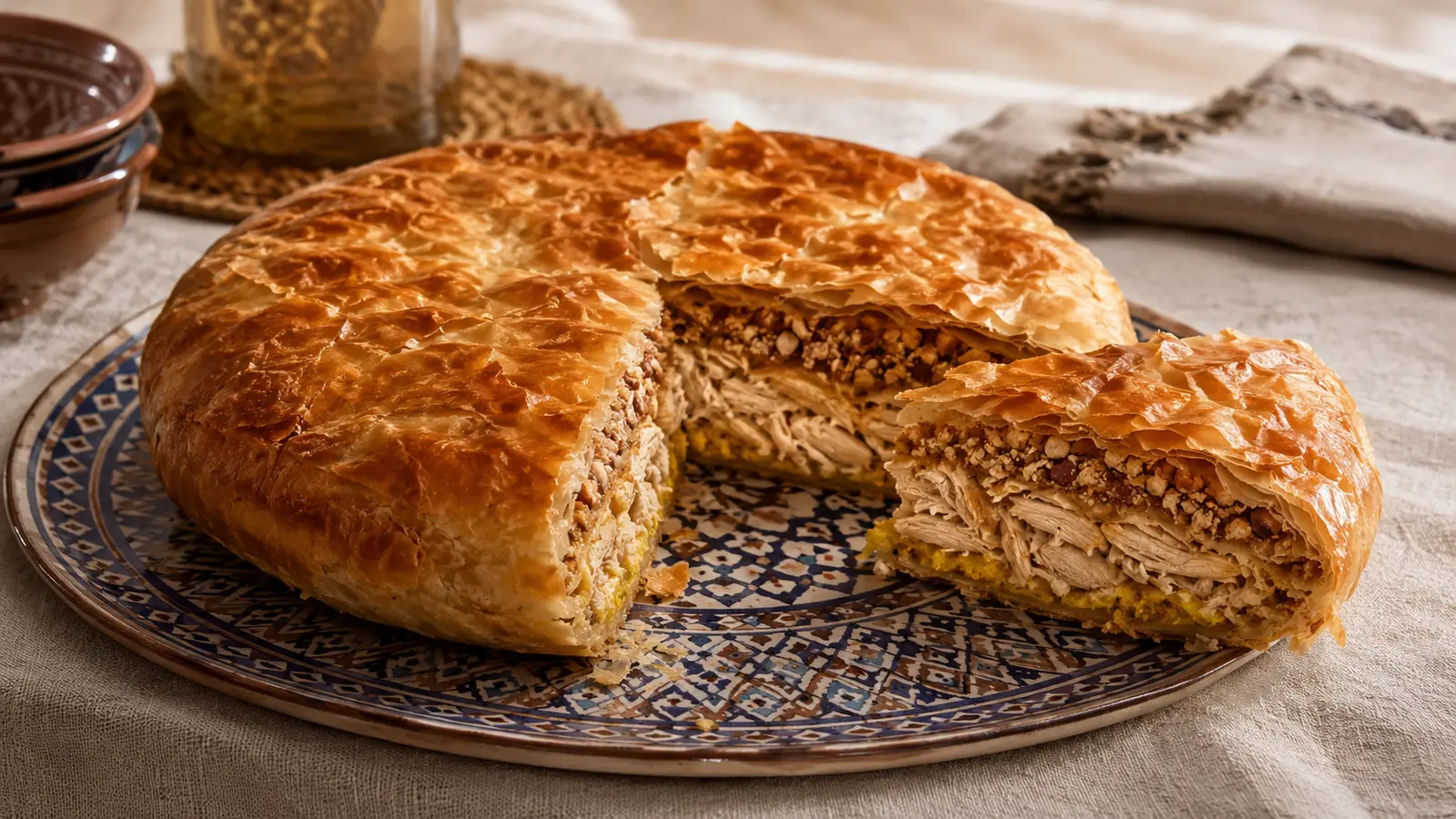
Pastilla's layered structure and regional/filling variations.
Pastilla may contain poultry, pigeon, seafood or other regional fillings. In this chicken version, the recognizable architecture is more important than a thick sugar coating: savory chicken below, softly set egg-onion layer, crisp almond mixture and thin pastry around all of it.
Fes is strongly associated with refined versions of the dish, but household and restaurant forms vary in size, sweetness and presentation. A dusting of sugar and cinnamon is optional; measured sweetness inside the almond layer is enough for a balanced pie.
- Layer check: a cut wedge should reveal chicken, egg-onion and almond as separate bands; mixing all three before wrapping creates a heavy filling with no contrast.
- Portion planning: a 28-centimeter pie makes eight meal wedges or twelve tasting pieces; choose the cut before dusting so serving sizes remain clear and the decorative pattern is not destroyed.
Check current details: Moroccan National Tourist Office — food and drink
Braising and shredding chicken without drying it.
Braise bone-in thighs with onion, ginger, turmeric, saffron, cinnamon and herbs. Thighs tolerate simmering better than breast. Remove them as soon as they reach 74°C/165°F and the joint loosens, then cool enough to handle and shred into broad pieces.
Discard bones and skin, but do not return chicken immediately to the broth. Keeping it separate prevents fibers from breaking down while the onion liquid reduces. Moisten with only a few spoonfuls of finished sauce before assembly.
- Chicken cue: shred along the muscle into pieces about finger-width, because fine fibers continue drying during the second cook inside the pastry.
- Cooling cue: spread both chicken and egg mixture no deeper than two centimeters on separate trays, then refrigerate promptly rather than nesting hot filling in one bowl.
Reducing onion-herb broth before slowly setting the egg layer.
After the chicken leaves, reduce the onion broth until a spoon dragged across the pan reveals the bottom for several seconds. Lower heat and add beaten eggs gradually, stirring into soft curds that absorb the remaining liquid. They should look moist but leave no watery pool.
Spread the egg mixture on a tray to cool quickly. If it releases liquid after cooling, drain it before assembly. This is the layer most likely to make pastilla soggy, so visual dryness is more important than adhering to a fixed reduction time.
- Egg cue: drag a silicone spatula across the pan; liquid that runs immediately into the path needs further reduction before eggs are added.
Toasted almond mixture and measured cinnamon-sugar balance.
Toast blanched almonds before grinding; raw almonds taste flat and contribute moisture. Pulse to a coarse crumb with sugar, cinnamon and a pinch of salt. Almonds should remain visible rather than become paste.
Use 40 grams sugar for a restrained filling and add more only if you know your table prefers a sweeter style. Orange blossom water is optional and powerful; one teaspoon perfumes the nuts without making the pastry taste soapy.
- Almond cue: cool toasted nuts completely before grinding so warm oils do not turn the measured crumb into almond butter.
Warqa versus filo: handling, buttering and overlapping sheets.
Warqa sheets are supple and usually need less fat. Filo tears more readily, so thaw it according to the package, keep it beneath a barely damp towel and brush each sheet lightly with clarified butter or oil. Too much butter pools at the bottom.
Overlap sheets in a round pan with generous overhang, add chicken, egg and almond layers, then fold inward. Cover the center with extra sheets and turn the pie onto a parchment-lined tray so the folded side becomes the base.
- Filo workflow: remove only the sheets being used and recover the stack immediately; dry edges crack before the wrapper can be folded tightly.
Assembly, flipping/finishing and crispness cues.
Bake until the pastry is deeply golden across the center and edges, not merely pale and dry. A metal pan conducts enough heat to crisp the bottom; a thick ceramic dish may require longer. Rest ten minutes so layers settle before cutting.
If the bottom is pale, slide the pastilla onto a preheated sheet for the final minutes. Do not broil an undercooked bottom: the top burns while the trapped underside remains soft. Dust only after the surface stops steaming.
- Bake cue: the center should sound dry and papery when tapped, while dark edges and a pale middle indicate uneven sheet overlap or oven heat.
Make-ahead stages, freezing and safe reheating.
Chicken, egg mixture and almonds can be prepared a day ahead in separate covered containers. Assemble immediately before baking. An unbaked assembled pastilla may be frozen solid, wrapped well and baked from frozen with extra time, provided its filling was chilled promptly.
Refrigerate baked leftovers within two hours and use within three to four days. Reheat uncovered in a 190°C/375°F oven until the center reaches 74°C/165°F and the pastry re-crisps. A microwave makes the wrapper soft and is a poor choice for this dish.
- Freezer label: record whether the pie is baked or unbaked and the filling preparation date so reheating instructions cannot be confused.
Check current details: Morocco food safety authority — ONSSA