
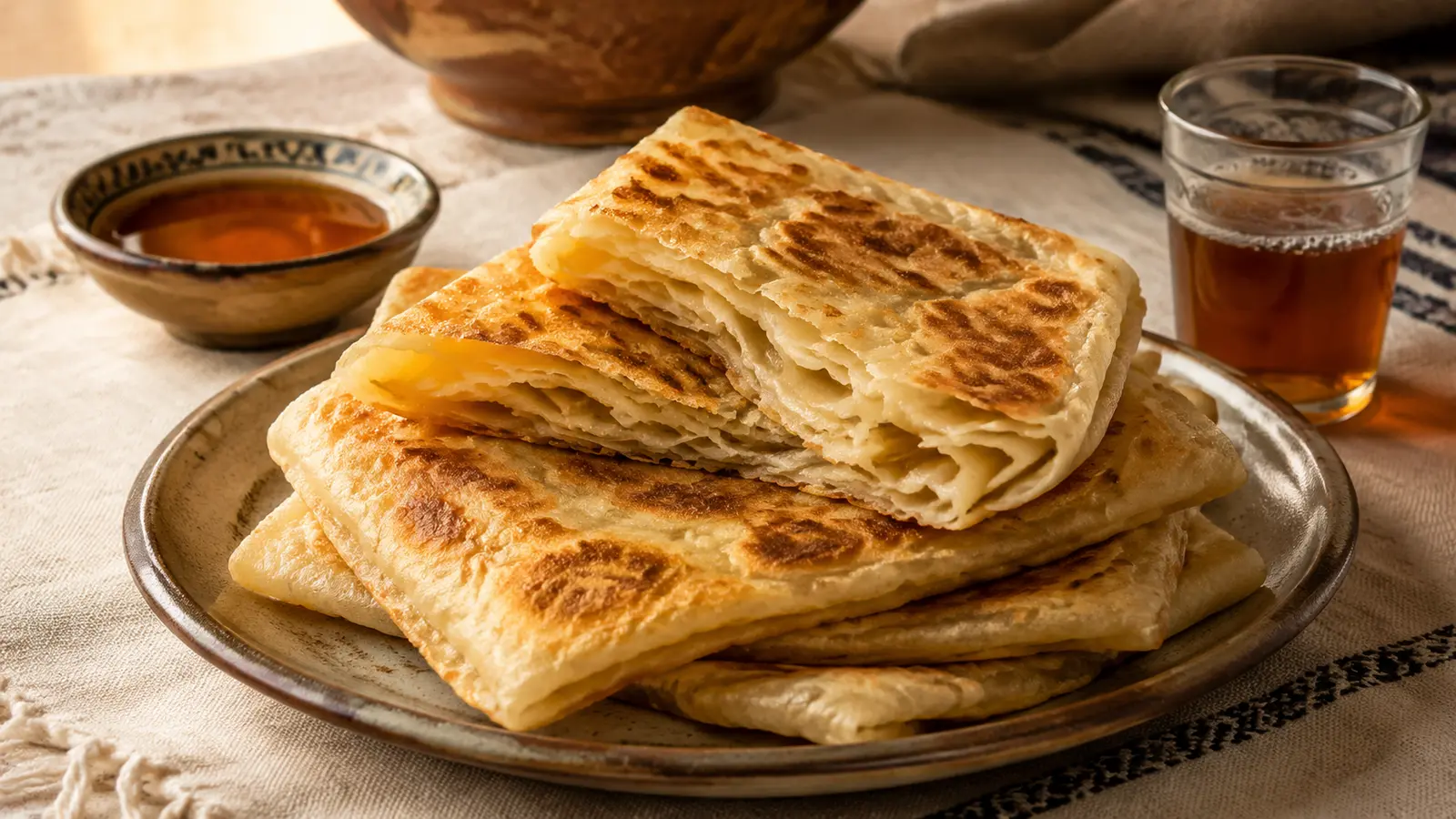
What makes msemen layered: dough strength, oil, semolina and rest.
Strong dough holds a thin membrane; oil prevents exposed surfaces from drying; fine semolina keeps folded sheets from welding completely together. Rest allows gluten to relax between shaping stages. Remove any one of these functions and msemen becomes a dense square rather than a layered bread.
Butter adds flavor but burns sooner than oil. A half-and-half mixture gives aroma and flexibility. Keep the semolina fine enough to disappear between folds; coarse grains puncture the stretched sheet.
- Layer model: every brush of fat separates dough surfaces, while semolina creates microscopic spacers; neither compensates for a sheet left thick and unstretched.
- Surface plan: clear at least a 70-centimeter square workspace and keep raw dough on one side and cooked breads on another so oil and flour do not turn the griddle area chaotic.
Check current details: Moroccan National Tourist Office — food and drink
Mixing and kneading to a smooth, extensible dough.
Combine bread flour, fine semolina, salt and water gradually. Knead by hand for 10 to 12 minutes or by mixer for 7 to 8, until the dough is smooth, elastic and capable of stretching into a thin window without immediately tearing.
Hydration varies with flour. Hold back 30 milliliters water and add it only if the dough is firm. If sticky, oil hands instead of adding handfuls of flour; extra dry flour reduces extensibility.
- Window test: a small dough piece should stretch thin enough for light to pass before the edge frays; a clean snap indicates more kneading or rest is needed.
- Salt placement: mix salt into the dry ingredients before water so one dough ball does not receive a concentrated patch that slows yeast or toughens a seam.
Dividing, oiling and resting without skin formation.
Divide into ten equal balls of roughly 95 to 100 grams with oiled hands, tucking rough edges underneath. Coat each ball completely with oil and arrange with space between them. Cover tightly so no skin forms and rest at least 30 minutes.
A longer cool rest is possible in the refrigerator. Bring the balls toward room temperature before stretching, while keeping them covered. Cold dough resists and can tear along its tight outer surface.
- Portion control: weigh balls rather than judging by eye so the last square is not twice as thick and left raw in the center.
- Rest timing: begin stretching the first ball only after the last one is covered, which gives early portions enough relaxation and keeps the whole batch on a predictable rotation.
Stretching paper-thin without tearing and the square fold sequence.
Oil a wide smooth work surface and press one ball outward from the center. Lift and stretch gently until the sheet is nearly translucent; small edge tears are acceptable. Brush with butter-oil and scatter fine semolina evenly.
Fold the left and right thirds inward to make a long rectangle, coating each new surface, then fold the top and bottom thirds to form a square. Rest the square 10 minutes before flattening to about 16 centimeters so layers do not burst.
- Stretching recovery: if the dough repeatedly springs inward, cover it and rest another ten minutes instead of forcing it until holes open.
Griddling temperature, flipping and doneness cues.
Heat a heavy griddle over medium, not high. Lay down a square and turn every 30 to 45 seconds, rotating position if the pan has hot spots. Repeated turning sets layers evenly and prevents one hard crust.
Done msemen is golden in patches, dry rather than doughy at the edges, and springs back lightly when pressed. Total time is usually four to six minutes per square. Lower heat if the first side darkens before the center puffs.
- Heat calibration: sacrifice the first small square as a test and note its total time; adjust burner position before committing the remaining nine pieces.
Sweet breakfast, savory stuffing and rfissa applications.
For breakfast, serve with honey and butter or soft cheese alongside mint tea. Savory versions can hold spiced onion or meat, but fillings need to be cooked, cool and fairly dry before folding so steam does not rupture the bread.
Rfissa uses plain msemen or thinner trid torn into pieces. Cook those squares slightly paler so they remain flexible and absorb broth. Do not sweeten a batch intended for rfissa.
- Filling limit: use no more than two to three tablespoons dry cooked filling per square, spread thinly enough that folded seams can seal.
Freezing dough or cooked breads and reheating crispness.
Cool cooked breads separately before stacking; trapped steam makes surfaces rubbery. Freeze with parchment between squares in a sealed bag for up to two months for best quality. Thaw briefly at room temperature or reheat directly from frozen over medium-low heat.
A skillet restores crispness better than a microwave. Warm each side until flexible and lightly crisp, without adding more oil. Raw dough balls can be refrigerated overnight under oil, but freezing folded uncooked squares is easier to portion.
- Freezer workflow: freeze cooled squares flat on a tray before bagging if parchment is scarce, then remove only the number needed for one breakfast.