
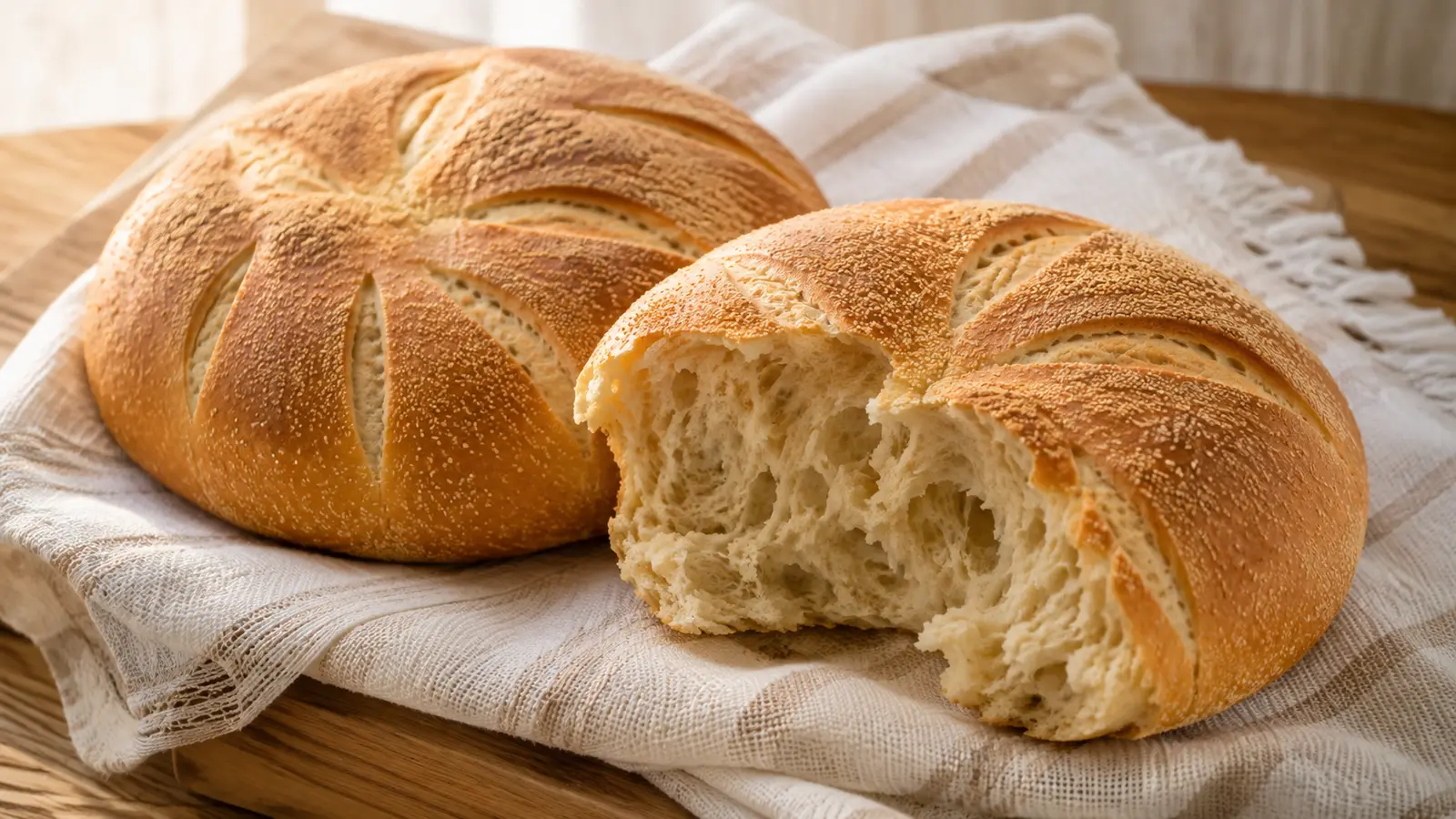
Khobz at the Moroccan table: utensil, staple and neighborhood-oven context.
Khobz functions as utensil and staple. Diners tear a small piece, use it to pick up food from the shared side of a plate and take a measured amount of sauce. Neighborhood ovens historically and currently shape some local routines, though home ovens are also ordinary.
Flour blends, size and scoring differ by household and region. Some loaves contain only white flour, others whole wheat, barley or semolina. The broad round and practical table role matter more than a single decorative scoring pattern.
- Table cue: tear pieces no larger than needed for one bite, which makes the loaf work as a utensil without soaking up disproportionate sauce.
- Batch plan: bake one loaf for the day and freeze the second as soon as it cools, preserving more freshness than leaving both rounds exposed for several meals.
Check current details: Moroccan National Tourist Office — food and drink
Flour and fine-semolina ratios, yeast and hydration.
Bread flour supplies gluten strength; fine semolina adds wheat flavor and a firmer bite. A 4:1 ratio keeps the loaf extensible. Instant yeast simplifies mixing, while ten grams salt seasons without slowing fermentation excessively.
Begin with 360 milliliters water and add up to 30 more as flour absorbs. Dough should be soft and slightly tacky, not batter-like. Whole-grain substitutions require more water and generally create a denser crumb.
- Hydration cue: after five minutes of kneading, the dough should clean most of the bowl while a fingertip still feels slight tack; a dry ball needs more water.
- Flour adjustment: reserve water rather than adding bench flour; each dry handful changes the ratio and produces a progressively denser loaf.
Kneading and bulk fermentation readiness cues.
Knead until the surface becomes smooth and a small piece stretches thin before tearing, about eight minutes by mixer or 10 to 12 by hand. A rough dough that rips immediately needs more kneading or a ten-minute rest, not necessarily more flour.
Let rise covered until roughly doubled and a floured fingertip indentation returns slowly. Temperature changes the time dramatically. Use the dough’s volume and resilience rather than forcing every kitchen into a 60-minute promise.
- Rise cue: measure the starting height in a straight-sided container if your kitchen is cool, because volume is more reliable than a recipe clock.
- Fermentation cue: a pleasant wheaty, lightly yeasty aroma is normal; solvent-like sharpness and a collapsing overinflated dough indicate the rise has gone too far.
Shaping flat rounds, proofing and scoring.
Divide into two, form tight balls and rest ten minutes. Flatten each to a 22-centimeter round about 2 centimeters thick on semolina-dusted parchment. Press evenly from center to edge so no thick dome remains uncooked.
Proof covered until visibly puffy, then prick or score the surface. Deep decorative cuts can deflate the broad loaf; shallow crosshatching is enough. Handle gently when transferring to the oven.
- Rise cue: measure the starting height in a straight-sided container if your kitchen is cool, because volume is more reliable than a recipe clock.
Home-oven temperature, stone/steel options and steam trade-offs.
Preheat oven and baking surface thoroughly to 230°C/450°F. A stone or steel gives strong bottom heat; an inverted heavy sheet is a good substitute. Slide loaf with parchment and reduce temperature slightly if the base colors too fast.
A small pan of boiling water can soften the early crust, but home khobz does not require dramatic steam. Never pour water onto glass or the oven floor. Remove the steam pan after ten minutes if used.
- Shape cue: press the center and outer ring to equal thickness before proofing; a domed middle stays damp while a thin rim dries.
Doneness by color, sound and internal temperature.
The loaf is ready when top and bottom are deep gold, the base sounds hollow when tapped and an instant thermometer reads about 93 to 96°C/200 to 205°F in the center. Color is essential; a pale loaf often has a damp, floury crumb.
Transfer directly to a rack. Covering immediately softens the crust, which some tables prefer, but wait at least 45 minutes before cutting so the crumb finishes setting.
- Oven cue: preheat a stone for at least 45 minutes or a heavy inverted sheet for 25, then bake one loaf at a time if side-by-side rounds block circulation.
Cooling, freezing and serving with tagines and salads.
Serve the same day with tagine, zaalouk, taktouka, harira or breakfast foods. Tear rather than pre-slice for a communal meal, and use a new piece after it touches the mouth rather than returning it to shared food.
Keep cooled loaves wrapped at room temperature for one day or freeze promptly in halves for up to two months for best quality. Refrigeration stales bread quickly. Reheat frozen bread in a 180°C/350°F oven until warm and lightly crisp.
- Thermometer placement: insert through the side into the center so the puncture is discreet and the probe does not read only the hotter bottom crust.