
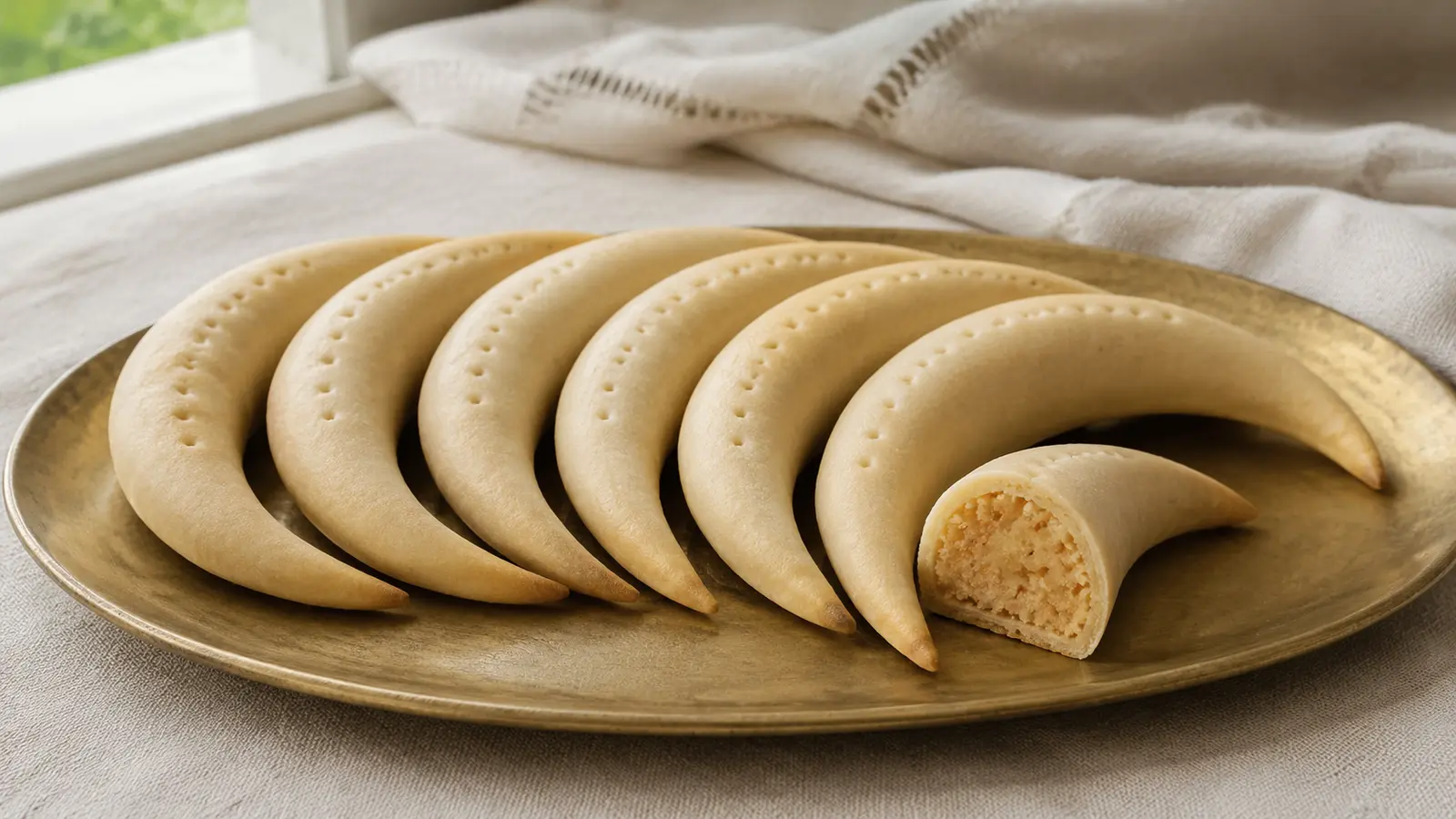
Understanding kaab el ghzal: the familiar gazelle-horn name, fine pastry work and variation across Moroccan kitchens.
Kaab el ghzal is associated with careful pastry craft, hospitality and celebratory sweets, but production differs across cities, bakeries and homes. Some wrappers are extremely thin, some fillings show more cinnamon, and decorative pinching or crimping may be elaborate or nearly absent.
The familiar crescent is the stable point. It should hold a generous almond center without bursting, with a shell thin enough to bend around the filling. Calling one edge pattern the only authentic form would flatten a living range of Moroccan practice.
- Use the pastry name and its common English nickname together so readers can recognize a menu without treating the translation as exact.
Check current details: Moroccan National Tourist Office — food and drink
Almond filling: grinding, orange blossom water, cinnamon and a moldable—not oily—paste.
Blanched almonds must be cool and dry before grinding. Pulse them with sugar until fine, then add cinnamon, orange blossom water and softened butter. Stop as soon as the mixture gathers; extended processing releases oil and produces a greasy paste that spreads during baking.
Squeeze a 20-gram portion and roll it on the board. It should form a smooth log without cracking or leaving an oil slick. If crumbly, add orange blossom water half a teaspoon at a time. If greasy, chill before adjusting with more ground almond.
- Choose food-grade orange blossom water with a clean citrus-floral aroma; a bitter or perfumed product can dominate the full batch.
Thin wrapper dough: hydration, rest and rolling without tearing.
The wrapper uses flour, salt, melted butter and a diluted orange blossom mixture. Knead until elastic, then rest under a bowl for at least 30 minutes. Rest is what allows very thin rolling without the sheet pulling back into a thick patch.
Divide the dough so only one piece is exposed at a time. Roll on a barely floured surface to about 1 millimeter, thin enough to see the work surface faintly through it. Brush away loose flour before enclosing the filling, since dry flour prevents a clean seal.
- If a rolled sheet keeps shrinking, cover it and rest ten more minutes instead of forcing it thinner and creating weak tears.
Forming even almond logs and sealing a clean crescent.
Weigh almond paste into 24 equal pieces and roll each into an 8-centimeter tapered log. Equal filling matters because pastry thickness is judged around the log. Place one near the lower edge of dough, fold the sheet over and press out air from center toward both ends.
Cut around the log with a pastry wheel, leaving a 7-millimeter sealed margin. Curve gently into a crescent and stand the fuller side upright. Avoid pinching the center so tightly that the almond paste pushes toward the tips and bursts.
- Keep finished crescents covered loosely until the whole tray is shaped so the earliest pieces do not dry far ahead of the last.
Drying, pricking and baking the pastries pale rather than browned.
Set the crescents on parchment and let the surface dry uncovered for 45 to 60 minutes in a cool room. This short rest helps the pastry hold its shape; it is not a license to leave egg or dairy fillings out all day. This formula contains no egg, but butter still benefits from a moderate room.
Prick each pastry two or three times with a fine needle so steam can escape without tearing a large hole. Bake at 175°C/350°F until the shell looks dry and the base shows the faintest gold, usually 14 to 18 minutes.
- Rotate the tray once if the oven browns unevenly, but do not wait for deep top color as a doneness signal.
Texture checks, common problems and measured corrections.
A correct shell is tender and thin, not raw or leathery. A dark base means the pan or rack position is too hot; a split top usually means trapped air, wet filling, a weak seal or overfilled center. Diagnose the location of the split before changing the whole formula.
If filling cracks during rolling, add liquid sparingly. If shaped pastries slump, chill the logs and reduce processing time next batch. If the shell is tough, check for excess bench flour, unnecessary kneading after rest or baking beyond pale gold.
- Bake one shaped pastry as a calibration piece when using unfamiliar flour or orange blossom water, then adjust only the remaining dough—not the documented ratio.
Serving, gifting, make-ahead work, storage and allergen notes.
Serve at room temperature with mint tea or coffee. On a mixed Moroccan sweets plate, one crescent provides enough almond richness beside a crumbly ghriba or a narrow slice of m’hanncha. Pack in a rigid box with parchment so the fine tips remain intact.
Almond paste can be made one day ahead and refrigerated airtight; bring it just soft enough to roll. Store baked pastries airtight at cool room temperature for three days for best texture or refrigerate up to one week. Freeze shaped unbaked pastries for up to one month and thaw in the refrigerator before drying and baking.
- Label any shared tray prominently: the almond filling is not visible until the pastry is broken.
Check current details: Agricultural Development Agency — Moroccan terroir products · Morocco food safety authority — ONSSA