
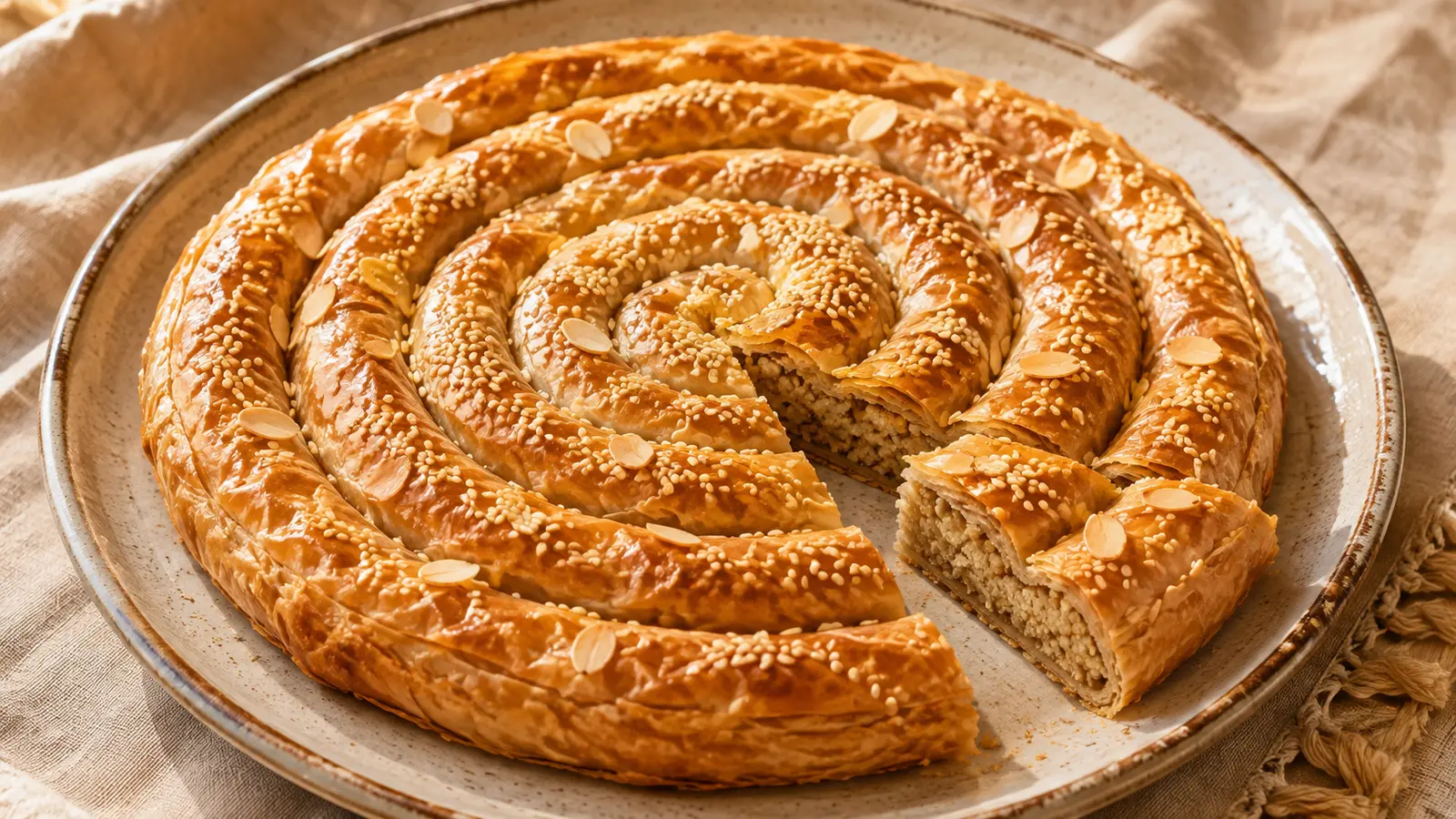
M’hanncha as a coiled pastry: name, presentation and the difference between shape and one fixed filling.
M’hanncha is often presented as one large spiral and sliced into wedges, although smaller individual coils also exist. The snake reference describes the long curved form. Almond and orange blossom are common, yet other nut and spice treatments belong to particular kitchens and occasions.
Treat the pastry as shared craft rather than a single fixed artifact. What readers need is a stable coil, crisp wrapper and filling that cuts cleanly. Decorative cinnamon, sugar, almonds or sesame can change without erasing that basic structure.
- Choose one large coil for a centerpiece or several smaller coils for easier service; do not change size without adjusting baking time.
Check current details: Moroccan National Tourist Office — food and drink
Building a fragrant almond filling that holds together without becoming greasy.
Grind cooled blanched almonds with sugar to a fine meal, then pulse in cinnamon, salt, orange blossom water, lemon zest, softened butter and one egg. The egg binds the filling for slicing; it also means the raw mixture must stay refrigerated whenever work pauses.
The paste should roll into a rope without sticking heavily to the board. If loose, chill for 20 minutes. If crumbly, add orange blossom water by teaspoons. Extra egg makes the center puff and leak, so it is not the correction for dry almonds.
- Process only until the paste gathers; a glossy smear on the bowl is a warning that almond oil is being released.
Warqa and filo handling: moisture, buttering and overlapping for long filled ropes.
Warqa is supple and thin; filo is drier and usually arrives as rectangles. Thaw filo in its unopened package according to the maker, then keep the opened stack beneath plastic and a barely damp towel. A wet towel directly on pastry creates glued sheets.
Brush sheets lightly with melted butter. For filo, stack three sheets for each rope, staggering a long edge by a few centimeters only if the wrapper needs more reach. Work with one sturdy strip at a time and recover the stack immediately so edges do not shatter.
- Discard sheets that have become wet or moldy; patch small dry tears with a buttered piece rather than doubling the entire coil.
Rolling, joining and coiling without splitting the pastry.
Divide filling into four equal ropes about 3 centimeters thick. Place one along the lower edge of a buttered strip, fold the ends inward and roll snugly without crushing. Seal with a light brush of beaten egg or butter, depending on the wrapper.
Begin the coil at the center of a parchment-lined round pan. Curve the first rope gently, then join the next beneath an overlapping pastry flap. Leave a few millimeters between rings; an extremely tight spiral traps steam and splits at the outer arc.
- Keep every seam on the underside and stagger the joins so one radial line does not become a structural weak point.
Baking for an evenly crisp spiral and a fully set center.
Brush the assembled spiral lightly with butter and bake at 190°C/375°F. A metal pan crisps the underside more reliably than thick ceramic. Rotate once and continue until the center rings and outer edge are evenly golden, usually 30 to 35 minutes.
The almond center should reach 74°C/165°F because it contains egg, and the pastry should sound dry when tapped. If the top colors early, shield loosely with foil while the center finishes. A pale center ring indicates that the coil was packed too tightly.
- Check temperature through a natural seam near the center, then return the pastry to the oven if either filling or wrapper is unfinished.
Honey or sugar finishing, portioning and balanced sweetness.
Warm honey only until fluid and stir in orange blossom water off heat. Brush a thin layer over the hot pastry rather than pouring a deep soak. The goal is shine and aroma with crisp edges. Confectioners’ sugar is an alternative finish once the coil is cool.
Rest 20 minutes before cutting with a serrated knife. Slice through the rings with short strokes so the filling stays aligned. A ten-wedge yield is rich enough for dessert; thinner pieces tend to collapse where multiple joins meet.
- Add toasted sliced almonds or sesame while the honey is tacky, keeping garnish sparse enough that the spiral remains visible.
Make-ahead assembly, reheating, storage and allergen-aware service.
The almond paste can be prepared one day ahead and refrigerated. The full coil can be assembled, covered and chilled for up to 12 hours before baking; brush with butter only just before it enters the oven. Do not hold egg filling warm during a long shaping session.
Store baked pastry covered in the refrigerator for up to four days. Re-crisp portions in a 180°C/350°F oven until the center is hot, then rest briefly. Do not re-glaze after every heating. Freeze an unbaked well-wrapped coil up to one month and bake from thawed refrigerator temperature.
- For allergen-aware service, use a clean knife and separate platter; the pastry contains almonds, wheat, egg and butter in every ring.
Check current details: Agricultural Development Agency — Moroccan terroir products · Morocco food safety authority — ONSSA