
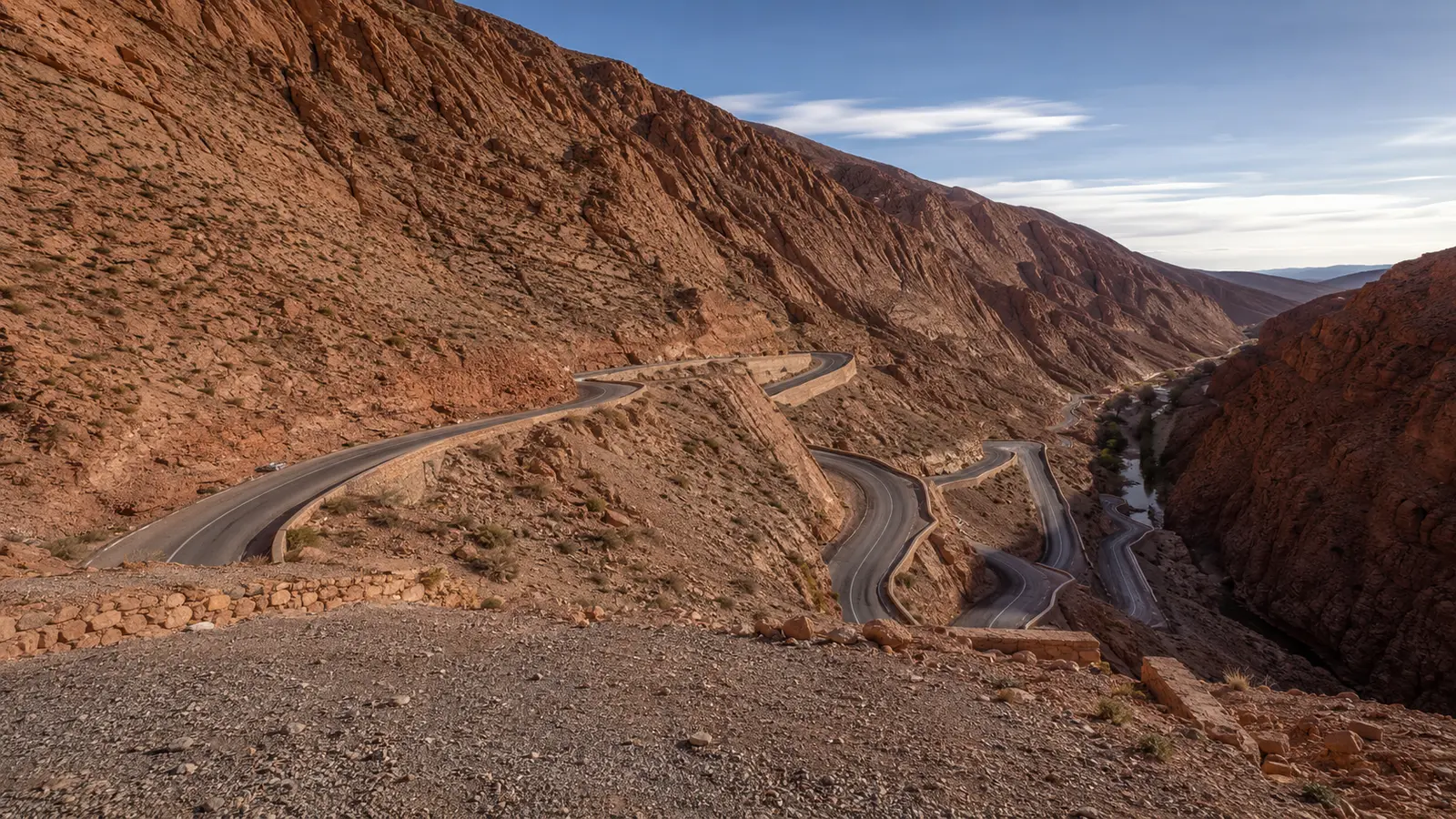
The corridor from Skoura to Tinghir
From Ouarzazate, the road reaches palm groves and kasbah landscapes around Skoura, the Roses Valley and Kelaat M’Gouna, Boumalne Dades and the Dades side road, then Tinghir and Todra. Merzouga lies farther east and should be treated as another major leg. Mark fuel, overnight and turnaround points before departure so scenic stops do not erase driving margins.
The side roads into Dades and Todra add distance beyond the main corridor, which is why a map can understate the day. Choose which gorge receives the longer walk before leaving the overnight base. Skoura or the Roses Valley can then become a deliberate earlier stop rather than another roadside delay added to an already full schedule.
- Skoura for oasis and kasbah context
- Boumalne as a Dades junction
- Tinghir as the Todra base
- Merzouga is a separate onward leg
Check current details: Moroccan National Tourist Office — rural heritage · Autoroutes du Maroc — official motorway network
Dades drive stops and pull-off safety
The Dades road reveals layered rock, villages and tight switchbacks, but viewpoints may have limited shoulders. Stop only where the vehicle is fully clear, visibility is adequate and local rules permit it. Never stand in the carriageway or ask a driver to reverse for a photograph. Use daylight, reduce speed before curves and let faster local traffic pass at a safe place.
Photographers should choose a legal pull-off, step out on the protected side and finish before rejoining traffic. Drivers need to concentrate on the road instead of responding to sudden requests to stop. A view skipped because the shoulder is unsafe can often be replaced by an established café terrace or signed overlook farther ahead.
- Use established pull-offs
- Keep every person off the road
- Do not stop on blind bends
- Finish the narrow-road section before dark
Todra walks and flash-flood awareness
The narrow gorge can become crowded where vehicles and pedestrians share limited space. Choose a walk that matches weather, footwear and daylight, and never enter a canyon or dry watercourse when rain is forecast upstream. Flash floods can occur far from the visible storm. Follow closures and local professional advice; a café stop outside the narrows is a better fallback than arguing with conditions.
Water can rise rapidly through a narrow canyon even when the local sky looks manageable. Ask about upstream weather and leave immediately when authorities, guides or residents advise it. Children should be kept close where traffic shares the gorge entrance. Climbing and extended hikes require their own qualified operator, equipment and route assessment.
- Check upstream weather
- Avoid watercourses during storm risk
- Wear shoes for uneven ground
- Respect vehicle-pedestrian conflict
Choosing an overnight
Stay where arrival before dark is realistic and the property gives clear access, heat or cooling information, meals and cancellation terms. Ask whether “kasbah” describes historic fabric, a modern style or only a name. Locally owned lodging can retain spending in the valley, but should still meet safety and hygiene needs. Do not enter nearby farms or homes without an explicit invitation.
An overnight in Boumalne, a side valley or Tinghir changes the next day’s driving balance. Compare access from the main road, meal availability and the actual walking route around the property. A building that looks isolated in marketing may still sit beside village homes or farms; guests should stay on public paths unless invited farther.
- Choose location by daylight reach
- Clarify meals and access
- Ask honest building-history questions
- Respect village privacy
Two days versus four days
Two days from Ouarzazate can cover a focused Dades or Todra route with one overnight, but attempting both deeply plus Merzouga is rushed. Four days allow Skoura, a valley night, a measured gorge walk and a safe onward segment. Add time rather than speed when traveling from Marrakech because the High Atlas crossing already consumes attention and daylight.
From Marrakech, the Atlas crossing and Ouarzazate region deserve at least one earlier night before a deep gorge route. With four days, a traveler can stop in Skoura, sleep near Dades, walk Todra and then continue safely. The two-day version should end before Merzouga unless it is explicitly designed as a transport-heavy transfer.
- Two days: choose a primary gorge
- Four days: connect valleys without racing
- Add a night when starting beyond Ouarzazate
Check current details: Moroccan National Tourist Office — rural heritage · Autoroutes du Maroc — official motorway network
Linking onward to Merzouga
Leave the final valley base early, verify the destination and camp pickup, and aim to reach the settled Merzouga area before dark. Do not schedule a dune transfer after an uncertain long drive. If delays grow, contact the operator and use a safe roadside overnight rather than pushing a tired driver. Sunset is optional; safe arrival is the itinerary’s non-negotiable success.
Camp operators may offer a late pickup, but that does not make the approach road safer. Ask for a settled-area hotel alternative when delays make the dune transfer impractical. Reaching Merzouga in daylight also lets travelers verify the operator, reorganize luggage and start the desert segment rested rather than disoriented.
- Confirm camp pickup in advance
- Aim for daylight arrival
- Communicate delays early
- Never chase sunset with dangerous driving